

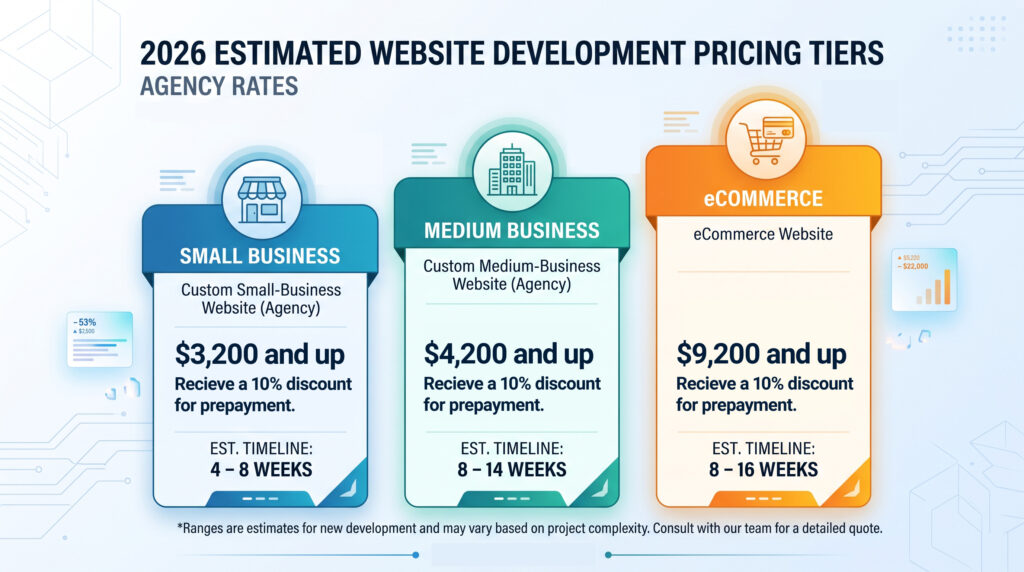
In 2026, a professionally designed small-business website costs $3,200 to $7,200. A custom medium-business website design runs $4,200 to $9,200, and eCommerce websites range from $9,200 to $22,000+. The average cost of a small business website depends on what your business needs the site to do. This guide explains what drives the price, what to budget after launch, and how to compare proposals fairly. VISIONEFX has quoted and built websites since 2000, so these numbers reflect what businesses actually pay.
How Much Does a Website Cost in 2026?
For most small businesses, a custom website costs $3,200 to $7,200. Medium-sized businesses with bigger sites and more integrations typically pay $4,200 to $9,200, and an online store costs $9,200 to $22,000 or more. Here is the short version, followed by the details behind each range.
2026 website costs at a glance
| Project Type | Typical 2026 Price Range | Typical Timeline |
|---|---|---|
| DIY builder (Wix, Airo, or Squarespace) |
$0 – $3,000 + your time |
Your nights, your weekends, your problem |
| Freelancer template customization |
$1,500 – $2,500 | 2 – 6 weeks |
| Custom small business website (agency) |
$3,200 and up depending on enhancements |
4 – 8 weeks |
| Custom medium business website (agency) |
$4,200 and up depending on enhancements |
8 – 14 weeks |
| eCommerce website | $9,200 and up depending on enhancements |
8 – 16 weeks |
| Advanced eCommerce (large catalog, ERP/ CRM integrations) |
$21,000 and up depending on enhancements |
12 – 24 weeks |
| Website maintenance and care plans |
$950 / $1,700 / $3,000 prepaid tiers |
Episodic — prepaid service agreements |
Professional agency projects at VISIONEFX start at $3,200. Ongoing care is handled through prepaid service tiers of $950 to $3,000 rather than open-ended monthly retainers. If the starting number surprises you, the sections below explain where it goes. They also explain why the “$400 website” you saw advertised usually costs far more than $400.
Custom web design: $3,200 and up
A custom small-business website from VISIONEFX starts at $3,200, depending on enhancements. That typically covers discovery, custom design, mobile-first development, on-page SEO, schema markup, form and email deliverability setup, and training so your team can edit content. If you are leaning toward a tailored design, see our custom web design services for small businesses, built from our home base in Virginia Beach, VA.
For instance, VISIONEFX redesigned The Beach Bully BBQ website and, like most of our small business website clients, took advantage of our 10% pre-payment discount for savings of $320.
Medium-business websites
Larger page counts, deeper content strategy, more integrations, and multiple stakeholders start at $4,200 and up, depending on enhancements, on an 8- to 14-week schedule.
How we compare with national agencies
Nationally, established agencies commonly quote mid-five figures to well into six figures, depending on platform and scope. Our range sits below that because you work directly with an in-house senior designer. You do not work through layers of account managers, project coordinators, or contractors that inflate every invoice. These numbers come from 25+ years of signed proposals and the 150+ five-star reviews from the businesses that approved them.
eCommerce website costs: $9,200 and up
A professionally built online store on WooCommerce or Shopify with up to a few hundred products typically costs $9,200 to $22,000, depending on enhancements. That includes product setup, payment and shipping configuration, and conversion-focused product page design.
Advanced eCommerce
Thousands of SKUs, ERP, CRM, or point-of-sale integration, custom checkout logic, and B2B pricing rules run $25,000 to $75,000+. If a vendor quotes a large-catalog store for $2,000, they are not planning to do the work that makes a store sell.
What Determines the Cost of a Website
Two websites can look similar and differ in price by 5x. The difference is rarely the design file. It is everything underneath it, and price follows scope. Most designers do not charge for a consultation, so it pays to shop around.
Size, complexity, and features
- Strategy and discovery: a professional build starts with your business: who calls you, what they search for, and what makes them choose you. Template work skips this, and it shows in the results.
- Page count and content: a simple site with a few pages, such as Home, About, and Contact, costs less than a large one. Building 5 to 10 pages takes far less time than 100 to 200, and a 10-page brochure site differs from a 40-page site with service and location pages. Copywriting, photography, and content migration add real hours.
- Custom design vs. template: custom design is built around your brand and conversion goals, not squeezed into a theme thousands of other businesses use.
- Features and integrations: a newsletter membership sign-up, booking system, CRM, payment gateway, quote calculator, or review feed each takes engineering and testing time. Some features need a custom database, and a complex database web application requiring custom programming varies even more, because it depends entirely on what the application must do.
- eCommerce: an eCommerce website costs more than a static brochure site. It requires product uploads, online card payment testing, shipping calculations, customer email order confirmations, and security requirements. Product count, variants, shipping rules, tax logic, and inventory syncing drive the price more than storefront design does.
- SEO and AI-visibility foundation: keyword mapping, schema markup, Core Web Vitals performance, llms.txt, and redirect mapping on redesigns. This is the difference between a website and a website that gets found, in Google and in AI engines like ChatGPT and Perplexity.
Requirements and deliverables
- Look and feel: the design should meet your expectations. Ask what multiple design changes or modifications will cost.
- Mobile-friendly: a mobile-ready website is a must-have. Responsive design adds design and testing across screen sizes, but most quality agencies include it.
- Speed: make sure your designer knows how to build a site that loads quickly on mobile and desktop, with clean code and optimized images.
- Content and graphics: writing, photos, and graphics may be included or priced separately.
The designer’s experience and accessibility
- Seasoned designers generally charge more than those just starting.
- Ask to see the designer’s website or online portfolio, and look up reviews from recent clients by name or company name.
- Establish how and when you communicate instructions and feedback, whether by text chat, email, phone, or virtual meetings.
Our guide on choosing a professional web designer goes deeper.
The $300–$500 “AI Professional” problem
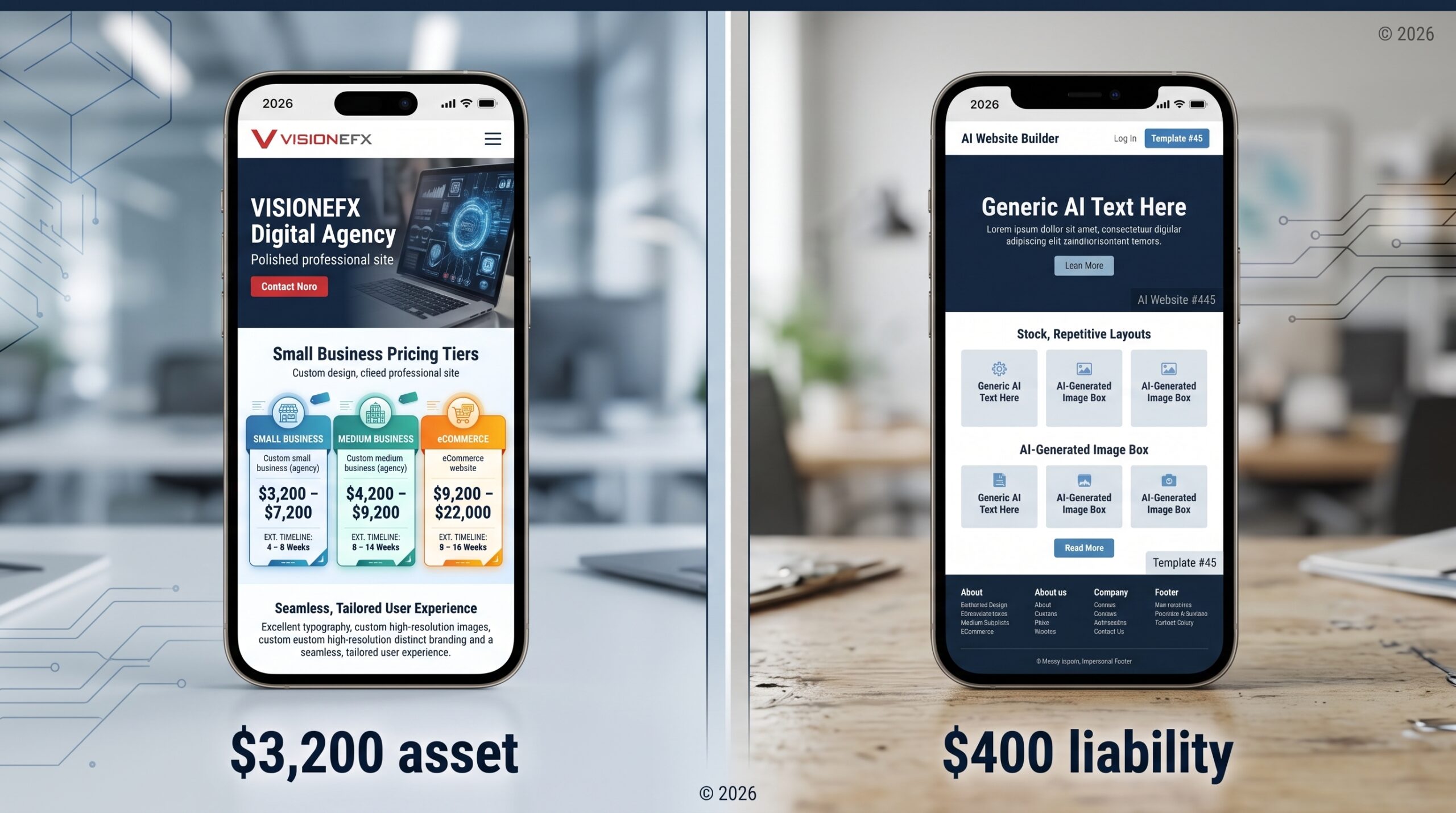
A wave of operators is using AI tools to pass themselves off as professional web designers, advertising complete business websites for $300 to $500. Businesses that buy them usually end up paying twice. If you are considering an AI-generated website, do your research first. Here’s why:
- No strategy, just prompt output. AI generates a generic layout in minutes, but nobody studied your customers, your competitors, or your search market. The result is interchangeable with ten thousand other AI-generated sites, and interchangeable websites don’t win customers.
- Invisible in search and AI engines. These builds skip keyword mapping, schema markup, Google Business Profile alignment, and service-area pages. Sometimes they’re not even properly indexed. A website nobody finds generates zero leads at any price.
- Fabricated and thin content. Unreviewed AI copy routinely invents claims, misstates services, and reads like filler. Google’s helpful-content systems suppress it, and AI engines won’t cite a source that contradicts itself.
- Technical corners everywhere. Bloated code that fails Core Web Vitals, forms that send leads straight to spam, no mobile QA, and no security updates. You don’t see these problems at delivery. You see them in your empty inbox.
- Ownership traps. Many of these sites are built inside the operator’s own platform account. Stop paying, and your domain, files, and content disappear.
- No accountability. No business history, no verifiable reviews, and no support after the payment clears. Before hiring anyone, check how long they’ve been in business and what their clients say publicly. You can verify our record in about ten seconds: established in 2000, 150+ five-star Google reviews.
AI itself isn’t the problem.
Professional agencies, ours included, use AI tools every day to work faster. The problem is unqualified operators using AI to simulate professional capability. In experienced hands, the tool accelerates good work. In inexperienced hands, it mass-produces junk at $400 a copy. The real cost of a $400 website is $400, plus months of lost leads, plus the $3,200+ rebuild, which is where many of our projects actually begin. For a fuller picture, see the advantages and disadvantages of an AI-generated website.
Contrary to what you may have read online about AI-built websites like GoDaddy AI, businesses will always need a custom-built professional website. The Bureau of Labor Statistics projects web developer employment to grow 16% between 2022 and 2032, much faster than the average across all occupations.
Ongoing Costs, Timelines and Long-Term Budgeting
Hosting, care plans and licenses
The build is not the last invoice, and any honest agency will say so up front. Plan for the following:
- Hosting: $15 to $60 per month for quality managed hosting. A $3/month plan costs you speed, and speed costs you rankings. Some designers host your site for a monthly fee; others don’t.
- Domain: $15 to $25 per year, plus SSL certificates.
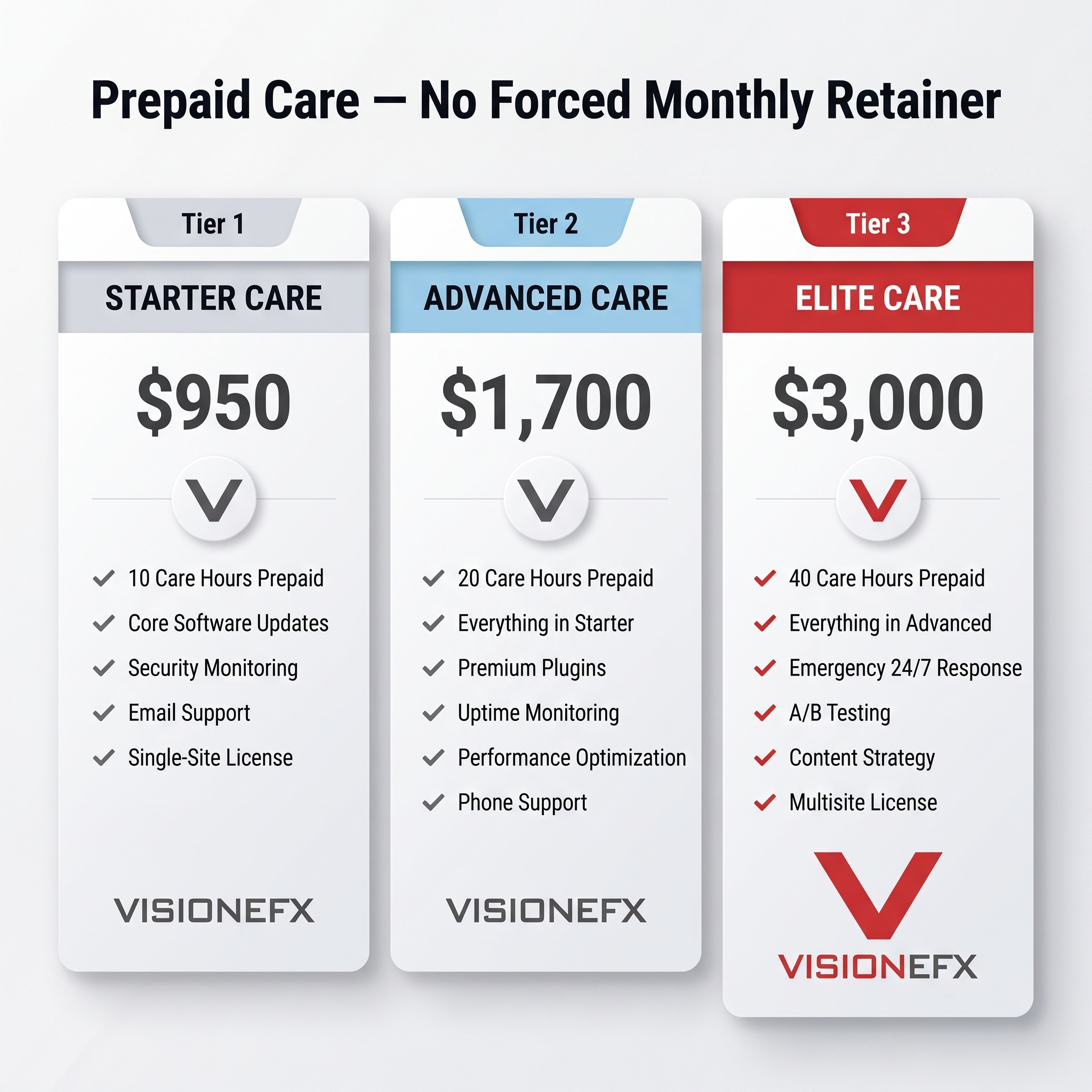
- Maintenance and care plans: across the industry, agencies commonly bill $75 to $300 per month as open-ended retainers. VISIONEFX structures website maintenance differently, with three prepaid tiers of $950, $1,700, and $3,000, sold as episodic service-level agreements. You purchase a defined block of software updates, security patching, backups, and support when your site needs it, instead of paying a monthly retainer whether anything happens. See our maintenance plans in Virginia.
- Premium plugin and platform licenses: commonly $100 to $500 per year depending on the stack.
- Content updates, security monitoring, and backups as your site grows.
- SEO beyond the basics: many designers treat SEO as an optional add-on. Sites built with SEO best practices tend to cost more up front, but they often save money over time by drawing more visitors. Ongoing SEO and custom performance work, such as caching or a CDN, can add cost.
Skipping maintenance entirely is the most expensive “savings” in web design. An unpatched WordPress site is a hacked WordPress site waiting for a date, and emergency cleanup plus reputation damage dwarfs the cost of a care tier.
How long does a website take to build?
Budget questions and timeline questions travel together. A small, simple site might take a few weeks, while custom features, e-commerce, or third-party integrations take longer. Realistic 2026 timelines from an established agency:
- Custom small-business website: 4 to 8 weeks
- Custom medium-business website: 8 to 14 weeks
- eCommerce website: 8 to 16 weeks
- Advanced eCommerce: 12 to 24 weeks
The biggest schedule variable isn’t design or development. It’s content readiness. Projects stall when text, photos, and product data arrive late. Agencies that quote “48-hour websites” are telling you there’s no discovery, no strategy, and no revision process.
How to budget: think in 3-year cost, not sticker price
The smartest way to budget is total cost of ownership. A $5,200 custom build amortized over three years is under $5 a day for the asset that generates your calls, quotes, and orders. Even with a $1,700 prepaid care tier, you’re still near $6 a day. Compare that honestly against what a lost month of leads costs your business, and the “cheap” option stops looking cheap.
Shopping for a Website Proposal
Vague requests get vague quotes. The more detail you provide, the more accurate and comparable the proposals you get back.
What to include in your request
- A summary of your website. For instance, what is its primary purpose?
- Your requirements in detail. List your must-have functions, such as ADA compliance.
- Examples of websites you’d like to use as a creative benchmark. For example, are you looking for an aeronautical or a technology theme?
After you receive proposals, compare costs and details. Then schedule a phone call with one or two vendors to see which is the better fit. Submitting your requirements to multiple designers is the best way to establish an average project cost.
Questions to ask every vendor
- Who owns the domain, hosting account, and files? The answer must be you.
- What exactly is included: pages, copywriting, SEO foundation, schema, training?
- What are the ongoing costs after launch, in writing? Are there costs for small changes after the site goes live, or for photos and graphics?
- Will your website be SEO mobile-ready?
- Will your website be AI-generated?
- How long have you been in business, and where can I read your reviews?
Established agencies answer these without flinching. VISIONEFX has been answering them since 2000. For more on preparing, read How to Prepare Your Website Development Plan and Planning Your Website’s Success.
How to compare bids
- Throw out the lowball bids. Low-cost bids may indicate substandard work.
- Throw out the high-end bids. High-cost bids may suggest the price exceeds fair market value.
- Accept bids within a few hundred dollars north or south of each other.
Prices in that middle range reflect actual fair market prices from reputable website companies. Price is only part of the decision. Choose a company that understands your business, so your website is customized to your needs and preferences, not poured into a generic mold. Pick a team that is easy to work with and responsive throughout the design process. Look for clear proposals that separate what’s included from extra costs, because a lower upfront cost may lead to higher maintenance, update, or performance costs later.
Two things you should own, whoever builds your site
- Register your domain name. Read more about Protecting Your Domain Name.
- Purchase your website hosting plan. Read more about Guard Against Losing Your Website.
Can I get a quote tailored to my business?
Yes. VISIONEFX typically provides a detailed estimate after learning your business goals, the features you need, your design preferences, and any technical requirements. We itemize everything the same way we have since 2000.
Are payment plans or phased development available?
Many design firms, including VISIONEFX, work with clients to phase a project, starting with core features and adding extras later, or to provide payment plans. Discuss this up front during the quote process.
For most website projects, the typical payment phasing is 50% to start the project and 50% upon the day your website goes live. Alternatively, we offer a 10% discount if you prepay. For example, $3,200 is discounted to $2,880, saving you $320.
Frequently Asked Questions About Website Costs
How much does a custom web design cost?
$3,200 to $7,200 for most small businesses in 2026, and $4,200 to $9,200 for medium-sized businesses with larger sites and more integrations. Many agencies quote $5,000 to $15,000 for comparable scope.
What’s included in a $3,200+ professional website?
Typically discovery and strategy, custom mobile-first design, 5 to 12 built pages, on-page SEO and schema markup, performance tuned for Core Web Vitals, forms with authenticated email delivery, analytics setup, and training. Every VISIONEFX build also ships with an AI-visibility foundation, including structured data and llms.txt.
What are ongoing website maintenance fees?
Many agencies bill $75 to $300 per month as open-ended retainers. VISIONEFX offers prepaid care-plan tiers at $950, $1,700, and $3,000, purchased when you need them rather than billed monthly. Hosting and domain registration are separate.
How much does an eCommerce website cost in 2026?
$9,200 to $22,000 for a professionally built store with up to a few hundred products, and $25,000 to $75,000+ for large catalogs with ERP, CRM, or point-of-sale integrations.
Why do website prices vary so much?
“A website” can mean anything from a reused template to a custom-engineered marketing asset. The main drivers are strategy and discovery, page count, custom design versus templates, copywriting, integrations, eCommerce complexity, and the SEO and schema foundation that determines whether the site gets found.
Is a $300 or $500 website worth it for a business?
For a business that depends on leads or sales, rarely. These builds typically lack strategy, an SEO foundation, and verified content, and they often come with ownership traps. Most end in a full professional rebuild.
How long does it take to build a website?
Four to 8 weeks for a custom small-business site, 8 to 14 for a medium-business site, 8 to 16 for eCommerce, and 12 to 24 for advanced eCommerce. Projects move fastest when you prepare content early.
Do I have to pay monthly for my website?
You’ll always have modest recurring costs: hosting and a domain. Maintenance doesn’t have to be monthly, thanks to our prepaid care tiers. You should never be forced to pay monthly for access to your own files. You should own your domain, hosting, and website outright. Please also read the FAQs for VISIONEFX best practices.
About VISIONEFX
VISIONEFX is a professional web design company based in Virginia Beach, Virginia. We are not just website builders but partners in your digital success. We take the time to understand your business and goals. That’s why your new website becomes a powerful marketing asset, and we know proper coding and software integration set websites apart. We offer web development services to small businesses nationwide, including custom web design, eCommerce, database, and WordPress web design. VISIONEFX also has Top Google Reviews posted on Google Business.
Ready for a real quote, not a guess? Please tell us what you need, including pages, features, and timeline, for a free consultation. Call (757) 619-6456 or email info@visionefx.net and tell us about your project.
Related reading: How Do I Start an E-commerce Business?, How Do I Start A Website?, Inexpensive Website Templates and Advantages of Owning Your Software.