

Why You Should Not Directly Post AI-Generated Content
A Summary & Strategic Guide for Bloggers (2025/26 Edition)
Based on insights from VISIONEFX and the latest industry studies on
- ChatGPT
- Gemini
- Perplexity
- Microsoft Co-Pilot

Part 1: Summary of “Can ChatGPT Content Be Identified?”
Source: VISIONEFX
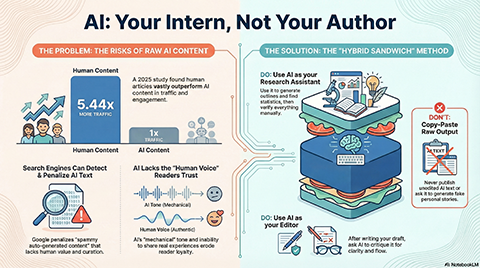
The VisionEFX article’s core message is clear: Yes, AI-generated content can be detected, and using it lazily risks your website’s reputation and ranking.
Key Takeaways:
- Detection is Real: AI content leaves “fingerprints” in the form of specific syntactic patterns, word choices, and sentence structures. Through linguistic analysis and natural language processing (NLP), search engines and detection tools can identify content that was written by a machine.
- Google’s Stance: While Google has stated it focuses on “quality” regardless of authorship, it strictly prohibits “spammy auto-generated content.” Content created programmatically without original value, sufficient editing, or human curation violates their Webmaster Guidelines.
- Watermarking: OpenAI and Google are actively developing “cryptographic watermarking” to tag AI content invisibly. This makes it easier for platforms to identify and potentially filter out mass-produced AI text.
- The Verdict: Publishing raw AI output is not an effective SEO strategy. The best use of these tools is for productivity—scaling research, generating outlines, or summarizing data—rather than replacing the human writer entirely.
Part 2: The 2025 Landscape – Latest Studies & Risks
Since the original article’s publication, the gap between “human” and “AI” performance has widened in unexpected ways. Here is what the latest 2024-2025 studies reveal about the major platforms.
- ChatGPT (OpenAI)
- Traffic Gap: In a 2025 NP Digital study of 744 articles, human-written pieces got 5.44 times more traffic than AI-written ones over five months.
- Engagement Drop: The study found readers spent much less time on AI-written pages. ChatGPT’s stiff, mechanical tone — even with advanced prompts — fails to connect emotionally, leading to higher bounce rates.
- Detection: Users are becoming sophisticated at spotting “GPT-speak” (e.g., overuse of words like “delve,” “landscape,” and “testament”).
- Google Gemini (formerly Bard)
- Integration with Search: With the launch of Gemini 3 and its integration into Google Search (AI Overviews), Google now prioritizes “Information Gain.”
- The “Deep Research” Shift: Google’s new agents focus on factual synthesis. If your blog post is just a generic AI summary, Google’s own AI will likely summarize the same information better than you can, rendering your post redundant. To rank in 2025, your content must offer original data, personal experience, or unique opinion—things Gemini cannot hallucinate authentically.
- Perplexity AI
- The “Answer Engine” Era: Perplexity operates differently; it acts as a research assistant that cites sources.
- Citation Optimization: Studies show that Perplexity favors authoritative, human-verified sources. If you post raw AI content, you are essentially reposting what the model already knows. To be cited by Perplexity (and drive traffic), you must be the primary source of new information, not a recycler of its own training data.
- Microsoft Co-Pilot
- Trust Factors: A 2025 Microsoft WorkLab study found that Co‑Pilot is great for drafting, but people must review its work to trust it.
- Text’s uncanny valley: Readers often sense when a personal story or advice lacks real empathy. Co-Pilot writes well in a professional, neutral tone, but it struggles to create a unique voice that builds a loyal blog audience.ng.
Part 3: Practical Applications for Everyday Bloggers
Don’t ban AI, but change how you use it. The winning strategy for 2025 is the “Hybrid Sandwich” method.
❌ DO NOT:
- Copy-Paste to Publish: Never take a raw output from ChatGPT or Gemini and hit “Publish.” It will likely be flagged as low-quality or spam by Google’s SpamBrain.
- Fake Personal Stories: Do not ask AI to “write a story about a time I failed.” It will sound generic and erode reader trust.
- Rely on AI Facts: AI still “hallucinates” (invents facts). Posting unchecked AI content can ruin your credibility.
✅ DO:
- The “Bottom-Up” Draft:
-
- Use AI to outline your post based on keywords.
- Use AI to research statistics (then verify them manually!).
- Write the content yourself to keep your unique voice.
- The Editor, Not the Writer:
-
- Write your rough draft, then ask AI: “Act as a professional editor. Critique this post for clarity and flow, but do not change the tone.”
- Write your rough draft, then ask AI: “Act as a professional editor. Critique this post for clarity and flow, but do not change the tone.”
- Meta & Distributables:
-
- Use AI to write your meta descriptions, social media captions, and newsletter teasers. This is “safe” content that Google explicitly accepts.
- Inject “EEAT” (Experience, Expertise, Authoritativeness, Trust):
-
- Google wants to see you in the content. Add photos you took, data you collected, or specific anecdotes from your life. AI cannot generate these real-world signals.
Final Verdict
Treat AI as your intern, not your author. The internet is flooded with average AI content. To stand out in 2025, your blog needs to be more human, not less.
About The Author
Rick Vidallon, the Creative Director at VISIONEFX, designs professional websites for small business owners throughout the United States.
Please read what our customers have to say about VISIONEFX on Google Reviews.
For more information, call (757) 619-6456 or use our contact form.