

Tips for Choosing the Best Color for Your Website
Choosing the right color palette is one of the most critical steps in web design.
Within the first 3 seconds of landing on a page, a visitor subconsciously judges your brand’s credibility and professionalism by its visual identity.
To create a high-impact website, you must balance the “WOW factor” mentioned by VISIONEFX with the psychological and accessibility standards researched by educational institutions.
1. The Psychology of Color
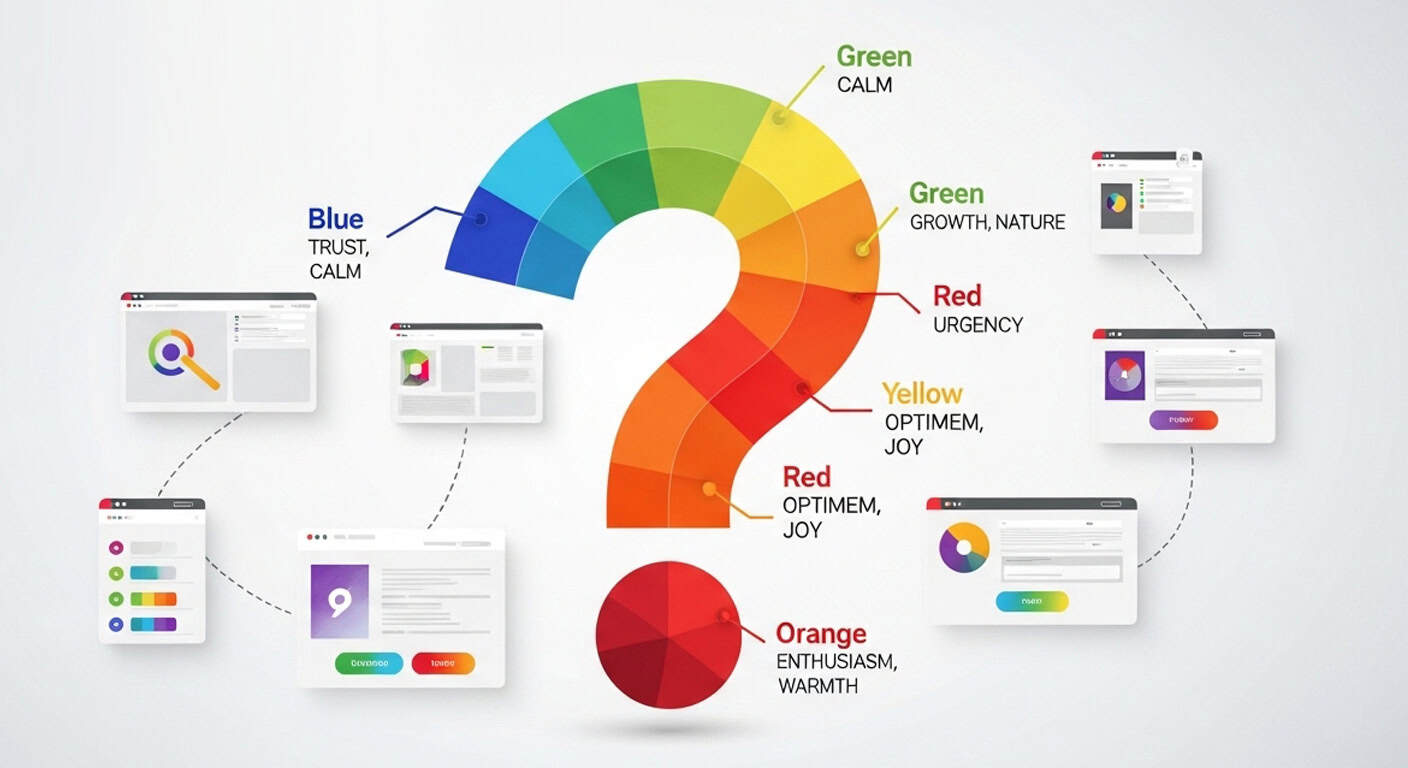
Colors are not just aesthetic choices; they are communication tools. According to the Los Angeles Film School, different hues evoke specific emotional responses:
- Blue: Often associated with trust, reliability, and professionalism. It is the gold standard for finance, healthcare, and technology firms because it creates a sense of security.
- Red: A powerful “action” color that signifies energy, passion, and urgency. VISIONEFX often uses red strategically in its custom designs to create a striking visual impact and drive customer action.
- Green: Symbolizes growth, nature, and tranquility. It is ideal for eco-friendly brands or businesses focused on health and wellness.
Black & White: Represent sophistication, power, and simplicity. A clean, minimalist design with these neutrals conveys a modern, luxurious aesthetic.
2. Strategic Palette Selection
Modern web design typically follows a structured hierarchy to prevent overwhelming the user. A typical professional guideline is the 60/30/10 rule:
- 60% (Primary Color): Usually a neutral or brand-centric color for backgrounds and large sections.
- 30% (Secondary Color): Used for subheadings and supporting elements.
- 10% (Accent Color): A bold, contrasting color reserved for Call to Action (CTA) buttons.
Common Color Schemes:
- Monochromatic: Variations of a single hue (e.g., shades of navy blue) for a cohesive, professional look.
- Complementary: Colors from opposite sides of the color wheel (like blue and orange) to create high contrast and energy.
Analogous: Colors next to each other on the wheel (like blue, blue-green, and green) to evoke a sense of harmony.
3. Technical Standards: Web-Safe Colors and Hex Codes
To ensure a website looks consistent across all browsers and devices, designers use HEX (Hexadecimal) colors.
- Consistency: Monitors have different color depths. Using web-safe palettes ensures your “brand red” looks the same on a laptop in New York as it does on a tablet in London.
Speed: Clean, optimized code—including color definitions—helps a website load quickly, which is a significant factor in search engine rankings.
4. Accessibility and Readability (WCAG)
Educational resources from Colorado State University emphasize that color choice is an accessibility issue.
- Contrast Ratios: To meet Web Content Accessibility Guidelines (WCAG), text and interactive elements should have a contrast ratio of at least 4.5:1. Black text on a white background provides the maximum contrast for readability.
Avoid Color-Only Cues: Never rely solely on color to convey information (e.g., using only a red border for an error). Use icons or text labels to ensure users with color blindness can navigate your site.
5. Branding and Online Reputation
Expert Rick Vidallon emphasizes that a consistent visual identity is key to defending your online reputation.
If your branding is “loud” or inconsistent across social media and your website, it can dilute your brand’s authority.
- Professionalism: A custom, original design lets you match icons, logos, and layouts perfectly, outshining competitors who rely on generic, “boxy” templates.
- Search Everywhere Optimization: Keep your colors consistent across TikTok, YouTube, and Facebook to build a recognizable brand footprint that AI search engines can easily associate with your business.
Based on the design philosophies of VISIONEFX (which emphasizes the “WOW factor” and custom branding) and established psychological principles from educational research, here are the color combinations and mood boards for Samsung and Apple as they appear in 2026.
1. Samsung: The “Dynamic Innovation” Mood Board
Samsung’s 2026 design strategy focuses on energy, connectivity, and a “Search Everywhere” vibrancy. It is content-rich and designed to look high-tech and globally accessible.
- Vibe: Kinetic, Vibrant, Bold, Connected.
- Visual Elements: Sharp 3D product renders with metallic finishes, vibrant neon accents, and interactive modules that encourage deep exploration.
The “WOW” Factor: High-contrast backgrounds that make product photography “pop,” aligning with the 3-second rule to grab attention immediately.
| Color | Hex Code | Role | Psychology |
| Samsung Blue | #1428A0 | Primary Branding | Trust, Intelligence, Stability |
| Onyx Black | #000000 | High-Contrast Backgrounds | Power, Sophistication, Depth |
| Pure White | #FFFFFF | Typography & Clean Space | Clarity, Efficiency |
| Cyber Cyan | #00E8FF | Interactive Accents | Future, Innovation, Energy |
2. Apple: The “Liquid Glass” Mood Board
Apple continues to lead with a minimalist philosophy. In 2026, they have moved toward a “Liquid Glass” aesthetic—a design style that uses translucency, soft shadows, and fluid transitions to create a premium, tactile feel.
- Vibe: Sophisticated, Zen, Fluid, Ultra-Premium.
- Visual Elements: Ample white space, macro-photography (extreme close-ups), and translucent “glassmorphism” layers that shift as you scroll.
- The “WOW” Factor: Extreme simplicity. By removing clutter, the user’s focus stays on the product, creating the unparalleled user experience Rick Vidallon advocates for.
| Color | Hex Code | Role | Psychology |
| Science Blue | #0066CC | CTAs & Interactive Links | Reliable, Modern, Helpful |
| Space Grey | #1D1D1F | Text & Depth Accents | Elegance, Tech-Authority |
| Athens Gray | #F5F5F7 | Soft Canvas / Backgrounds | Calm, Professional, Clean |
| Translucent White | rgba(255,255,255,0.7) | “Liquid Glass” Overlays | Fluidity, Modernity |
Summary: Which strategy fits you?
- Choose the Samsung Style if your brand is about energy, variety, and cutting-edge features. This style is perfect for businesses with a lot of information to share and that want to appear “active.”
- Choose the Apple Style if your brand is about luxury, simplicity, and premium status. This works best for businesses that want to say more with less and focus on “quality over quantity.”
🎨 Brand Identity Direction Checklist
Use this checklist to evaluate your business goals against the Samsung (Dynamic) and Apple (Minimalist) design philosophies.
1. Define Your Brand Personality
- [X] Energetic & Active: Does your brand thrive on excitement, speed, and variety? (Aligns with Samsung)
- [X] Calm & Sophisticated: Is your brand about luxury, focus, and premium quality? (Aligns with Apple)
- [X] Community-Focused: Are you building a local “neighborhood” authority? (Aligns with a hybrid “Search Everywhere” approach)
2. Identify Your Primary Message
- [X] “We do it all”: You offer a wide range of features, products, or services. (Best suited for high-energy layouts and mega-menus)
- [X] “We do it best”: You offer one specialized, high-tier service. (Best suited for minimalist “Liquid Glass” aesthetics)
3. Evaluate Your Content Assets
- [X] Visual Variety: Do you have many photos/videos of different products, locations, or team members? (Samsung style)
- [X] Macro Focus: Do you have a few iconic, high-quality images of a single flagship product or service? (Apple style)
4. Determine Your Search Strategy
- [X] Discovery-Driven: You want to be found on TikTok, YouTube, and Google Maps simultaneously. (Requires vibrant, high-contrast colors)
- [X] Reputation-Driven: You want to be the “Apple of your industry,” where your name alone signifies trust. (Requires muted, sophisticated palettes and high-trust reviews)
5. Technical & Future-Proofing Goals
- [X] AI Readiness: Is your brand identity clear enough for AI Agents to identify your brand across the web?
- [X] Mobile First: Will your chosen colors maintain high contrast (4.5:1 ratio) on small smartphone screens?
Which Direction Wins?
The Samsung Path: If you checked more boxes in the “Energetic” and “Discovery” categories, your brand should embrace bold blues, neon accents, and feature-rich layouts.
The Apple Path: If you checked more boxes in the “Sophisticated” and “Reputation” categories, your brand should lean into white space, soft grays, and a “less is more” custom design.
Building a cohesive visual identity takes more than picking colors; it requires a strategic combination of typography, button styles, and layout.
Following the design standards of VISIONEFX and Rick Vidallon, here is a Visual Style Guide for the two primary brand directions.
🏗️ Visual Style Guide: Path A
The “Dynamic Discovery” Direction (High-Energy & Active)
This style is best for businesses that offer a wide range of services, target local “near me” discovery, and want to appear cutting-edge.
- Typography:
- Headings: Use a bold, condensed sans-serif like Oswald or Montserrat. This creates a sense of authority and urgency in your 3-second window.
- Body Text: Use a highly legible sans-serif like Open Sans or Lato. These fonts are “web-safe” and ensure your bite-sized nuggets of info are readable on all devices.
- Button Styles (CTAs):
- Appearance: Use “Iconic” call-to-action buttons. These are large, high-contrast buttons (e.g., Vibrant Red or Cyber Cyan) that often include an icon (like a phone 📞 or a calendar 📅).
- Placement: Place these prominently “Above the Fold” and at the end of every central service section.
- Layout Features:
- Mega-Menus: Essential for organizing gadgets, widgets, and diverse services without burying pages.
Dynamic Banners: Use Photoshop-composite images that show your team in action or your storefront to build local trust.
💎 Visual Style Guide: Path B
The “Premium Minimalist” Direction (Sophisticated & Focused)
This style is ideal for luxury brands, professional services (like Legal or Medical), and businesses that want to convey a “less is more” premium status.
- Typography:
- Headings: Use a modern serif like Playfair Display or a lightweight geometric sans-serif like Avenir. This conveys elegance and professional credibility.
- Body Text: Use a clean, airy sans-serif with generous line spacing (e.g., Helvetica Neue or Roboto Light).
- Button Styles (CTAs):
- Appearance: “Ghost Buttons” (buttons with a thin border and transparent background) or sleek, monochrome solid buttons. The focus is on subtle guidance rather than a loud “shout.”
- Interaction: Smooth hover effects that change the button’s opacity or color slightly, signaling a premium user experience.
- Layout Features:
- White Space: Maximize space to let your custom Photoshop graphics breathe.
- Micro-Interactions: Use fluid transitions and soft shadows (glassmorphism) to create a tactile, high-end feel.
🛠️ Implementation Checklist
Regardless of the path you choose, VISIONEFX emphasizes three technical non-negotiables:
- Mobile-First Indexing: Your style guide must work on a smartphone first. Google maintains a separate mobile index, and if your buttons are too small or fonts are unreadable, your ranking will suffer.
- Fast Loading: Creative design should never come at the cost of speed. Use optimized Photoshop designs to ensure your “WOW factor” loads in under 3 seconds.
- Consistency: Ensure your chosen style is mirrored across your Search Everywhere profiles (TikTok, YouTube, Facebook) to protect your brand identity.
About The Author
Rick Vidallon, the Creative Director at VISIONEFX, designs social media websites for small business owners throughout the United States.
Please read what our customers have to say about VISIONEFX on Google Reviews.
For more information about Web Design Services, contact us at (757) 619-6456.
You may also reach us by email at info@visionefx.net.