

The Search Engine You Ignored Is Feeding ChatGPT: Why Bing Suddenly Matters Again
Be honest — when was the last time you thought about Bing? For most business owners, the answer is somewhere between “2011” and “never.” Google owns roughly 90% of search, so Bing became the punchline, the default you switched away from on a new laptop.
Here’s the plot twist: while you were ignoring Bing, the AI tools your customers now use every day quietly plugged into it. When someone asks ChatGPT or Microsoft Copilot to recommend a business like yours, a big part of that answer is assembled from what Bing knows. If Bing doesn’t know you exist, neither do they.
Where AI Assistants Actually Get Their Answers
 AI assistants don’t have a magical view of the internet. When they need live information — “government contractors in Virginia“, “best foundation repair company near me,” “top industrial flow meter manufacturers” — they query a search index, read the results, and synthesize an answer with citations.
The OpenAI–Microsoft partnership
ChatGPT’s search feature launched on Microsoft’s infrastructure through the OpenAI–Microsoft partnership, with Bing as its primary documented web source — and early research found that over 87% of ChatGPT search citations matched Bing’s top results.
OpenAI now runs its own crawlers.
By 2026, the picture has become more layered: OpenAI now runs its own crawlers (OAI-SearchBot, ChatGPT-User, GPTBot) and blends multiple sources into its retrieval stack. But here’s the practical bottom line from those who track it closely: Bing indexation remains the floor check. A page that ranks nowhere in Bing and is absent from OpenAI’s own crawl is unlikely to be retrieved at all.
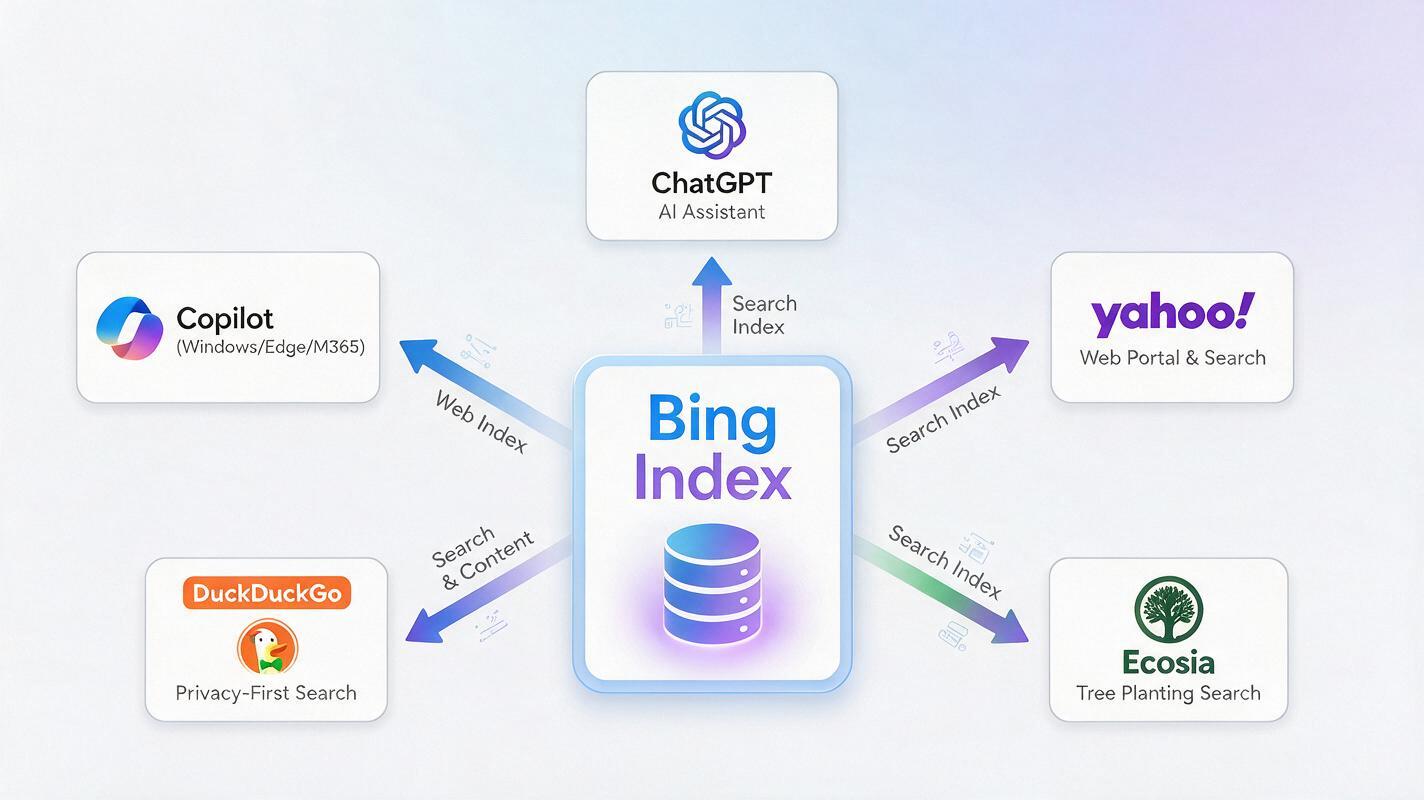
Microsoft Copilot is even more direct — it runs on Bing’s index, full stop, and it ships inside Windows 11, the Edge browser, Bing itself, and Microsoft 365. That puts Bing’s index in front of an enormous base of everyday and enterprise users who never typed “bing.com” in their lives. And the quiet kicker: DuckDuckGo, Yahoo, and Ecosia have long drawn on Bing’s index too.
One index, many doors. Optimize for it once, and you’re visible through all of them.
The Numbers Behind the “Tiny” Search Engine
Yes, Bing’s global market share hovers around 4.5% against Google’s 91% — that’s the stat that earned it a decade of neglect. But the composition of that share is what matters for a business.
Bing crossed 1 billion monthly active users for the first time in April 2026 and handles over 450 million searches a day.
It’s strongest exactly where buying decisions happen: on desktop, during work hours, inside the Microsoft ecosystem — Bing’s U.S. desktop share runs many multiples of its mobile share. The demographics skew professional and affluent, with roughly half of Bing users in the top quartile of household income and 41% of U.S. users earning over $100K a year.
If you sell to homeowners, businesses, or anyone who approves invoices, that’s your buyer. Then add the multiplier that didn’t exist three years ago: every ChatGPT query that touches Bing’s pipeline, every one of the billions of Copilot conversations users have had through Bing and Edge. Bing stopped being a 4% traffic channel and became infrastructure for AI answers — while remaining the least competitive major platform to optimize for, because your competitors are still treating it like a punchline.
A Tale of Two Indexes: What Our Audits Keep Finding
Here’s the assumption that gets businesses in trouble: “If I’m on Google, I’m on the internet.” Bing is not a miniature Google. It’s a separate index, crawled by a separate bot, ranked by different signals — and the two regularly disagree.
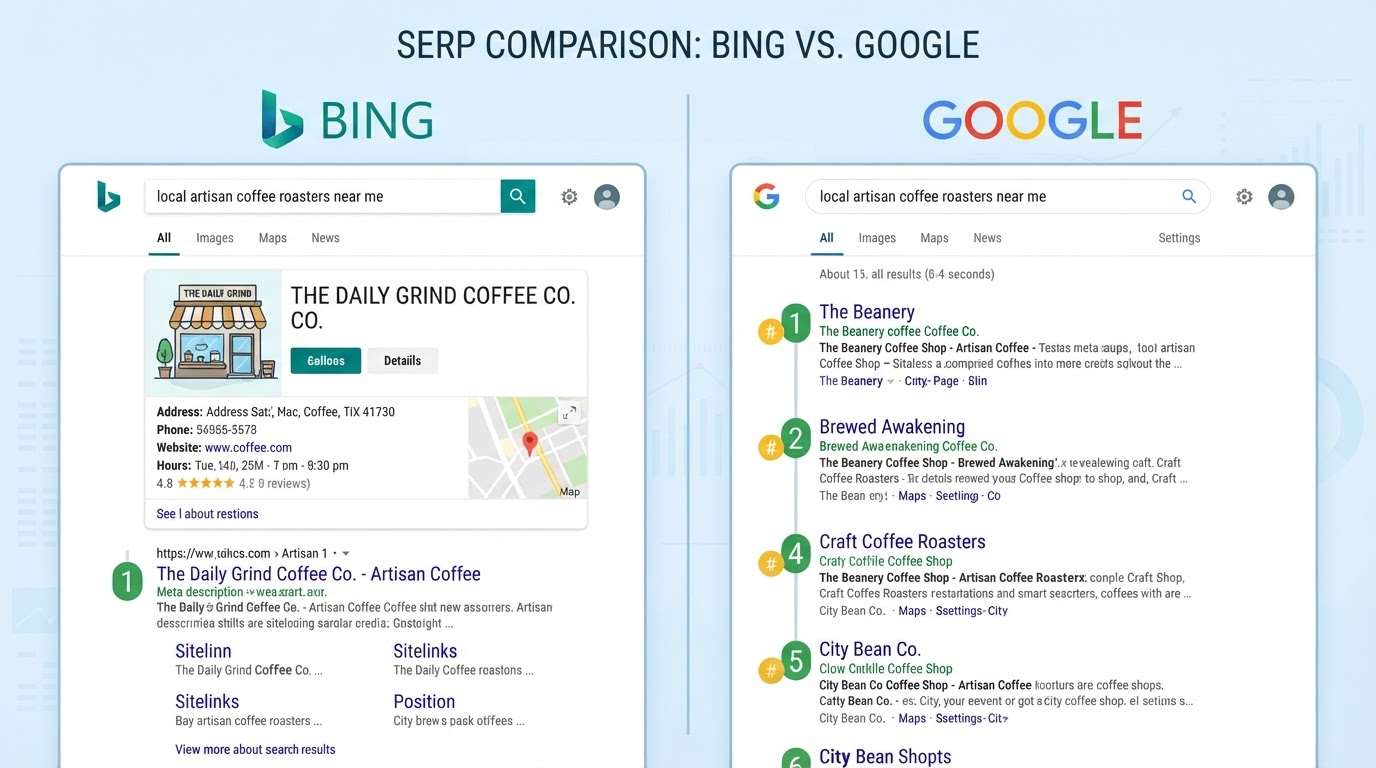
Google versus BING search results
We see it in audits all the time. Recently we reviewed a professional-services firm that ranked on page one of Bing for its money keywords while barely registering on Google — same site, two completely different realities. The reverse happens just as often: sites that perform fine on Google can turn out thin or missing in Bing’s index because of a stray robots.txt rule, a firewall quietly blocking Bingbot, or a sitemap that was never submitted to Bing Webmaster Tools. Nobody noticed, because nobody ever looked.
The two engines also weigh things differently. Bing puts comparatively more emphasis on exact-match keywords, clean HTML structure, established domains, and quality backlinks. And there’s a technical wrinkle unique to the AI era: even where Bing’s crawler renders JavaScript, ChatGPT’s live-fetching bot may see an empty shell on pages that depend on client-side rendering — one more reason well-built, server-rendered sites keep winning. It’s the same clean-structure story we made in our website redesign — the fundamentals that please Google, please everything downstream of Bing, too.
Bing Places: The 15-Minute Local Listing Your Competitors Skipped
For local businesses, the fastest win in this whole article is Bing Places for Business — Microsoft’s free equivalent of Google Business Profile. It controls how you appear in Bing search and Bing Maps, and it feeds the local business data that Copilot and Bing’s AI experiences draw on. When an AI assistant is asked for “a good plumber near me,” and your Bing listing is unclaimed, it assembles the answer from scraped, stale, or plain-wrong data about your business.
Microsoft Relaunches Bing Places
Microsoft clearly knows what it has: it relaunched Bing Places in October 2025 with an improved Google import, bulk editing for multi-location businesses, real-time status updates, and a new Recommendation Tool. The killer feature is still the import — connect your Google Business Profile, and Bing pulls in your name, address, phone, hours, categories, photos, and description in one shot, with an optional ongoing sync so future Google updates flow through automatically.
Two pieces of professional advice. First, clean up your Google profile before importing, because the sync copies your mistakes too. Second, keep your NAP — name, address, phone — identical across both platforms down to the abbreviation; inconsistency erodes trust signals on both.
And a note on expectations: an accurate listing makes you eligible and verifiable in AI-assisted local results; nothing “controls” what Copilot recommends. Accuracy is the play. Our local SEO service handles this cleanup as standard.
The 30-Minute Bing Visibility Checklist
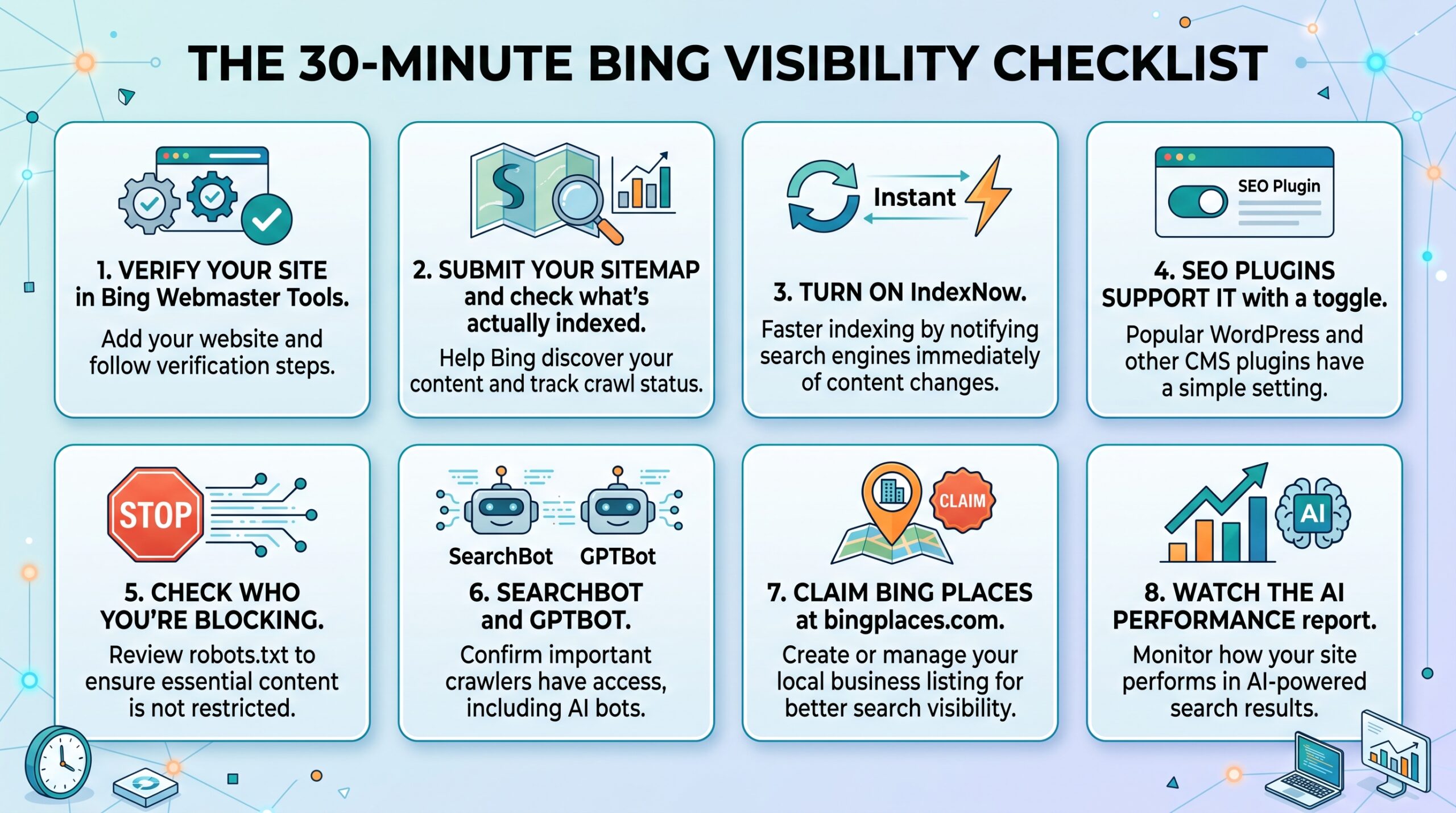
- Verify your site in Bing Webmaster Tools. Fastest path: use the built-in option to import your verified sites straight from Google Search Console — no code, no DNS edits.
- Submit your sitemap and check what’s actually indexed. Don’t assume. Review index coverage, inspect your money pages, and note anything missing.
- Turn on IndexNow. This free protocol pings Bing the moment you publish or update a page so that new content can enter AI retrieval pools the same day instead of weeks later. Most major WordPress
- SEO plugins support it with a toggle. Freshness measurably improves citation odds.
- Check who you’re blocking. Confirm your robots.txt and firewall aren’t blocking Bingbot — it happens more than you’d think — and make a deliberate decision about AI crawlers like OAI-
- SearchBot and GPTBot. If you want to be findable in ChatGPT, leave the door open.
- Claim Bing Places at bingplaces.com. Import from your Google Business Profile, verify, enable sync, and confirm the imported fields are accurate.
- Watch the AI Performance report. Bing Webmaster Tools launched this report in public preview in February 2026—it shows how often Copilot and Bing’s AI experiences cite your content. It’s the closest thing to a free AI-citation analytics tool, and almost nobody knows it exists.
Total time: about half an hour. Competitive advantage: measured in years, because your competitors won’t do it.
FAQ
Does ChatGPT really use Bing for search?
Bing has been ChatGPT search’s primary documented source since launch, and early research found the overwhelming majority of its citations matched Bing’s top results. By 2026, OpenAI blends Bing with its own crawlers and other sources — but pages missing from Bing’s index and OpenAI’s crawl are unlikely to be retrieved at all, which is why Bing indexation remains the practical baseline for ChatGPT visibility.
If I rank on Google, don’t I automatically rank on Bing?
No. Bing is a separate index with its own crawler and ranking signals—favoring exact-match keywords, clean code, established domains, and strong backlinks somewhat more than Google does. Sites regularly perform well on one and poorly on the other, sometimes for reasons as simple as a blocked bot or an unsubmitted sitemap.
Is Bing Places free, and do I need it if I have a Google Business Profile?
It’s completely free, and yes — your Google profile does nothing for you inside Bing search, Bing Maps, or the Microsoft ecosystem that Copilot lives in. Since Bing Places imports directly from your Google Business Profile and can stay synced, there’s no good argument for skipping it.
What is IndexNow?
IndexNow is an open protocol that instantly notifies Bing (and other participating engines) when you publish, update, or delete a page, rather than waiting for the next crawl. It’s free, supported by the major WordPress SEO plugins, and it helps ensure AI systems reference the current version of your content.
Should I block AI crawlers like GPTBot?
That’s a business decision, but understand the trade: blocking OpenAI’s crawlers removes your content from ChatGPT’s retrieval pipeline, which increasingly means removing yourself from answers your customers see. For most businesses seeking visibility, allowing search-oriented AI crawlers while monitoring server load is the sensible default.
The Bottom Line
Bing spent fifteen years as the search engine nobody chose — and then became the index the AI era was built on. ChatGPT leans on it, Copilot runs on it, and a string of other engines resolve to it, while your competitors keep ignoring it entirely. That’s the rarest thing in digital marketing: a genuine visibility channel with almost no competition, claimable in an afternoon.
The ten blue links are fading, and as we covered in our article on AI-driven search, the businesses that win next are the ones AI systems can find, verify, and cite. Bing is the unglamorous back door into those answers.
Want to know what Bing — and by extension ChatGPT — currently sees when it looks at your business? Request a Bing & AI visibility check, and we’ll run the audit.