

Selling to the U.S. Government? Your Website Needs Bing SEO
Most companies pour 100% of their search budget into Google — and for consumer brands, that math usually works. But if your customers are federal, state, or local government agencies, there’s a blind spot in that strategy, and it’s costing you visibility exactly where your buyers are looking.
FACT: The contracting officer, program manager, or procurement specialist researching vendors for their next award isn’t searching the way you do at home. They’re on a government-issued Windows laptop, inside Microsoft Edge, on a locked-down network — and there’s a very good chance their query is going to Bing, not Google.
Let’s take a closer look at why Bing deserves a dedicated line in every government contractor’s marketing plan, how Microsoft’s Copilot rollout raises the stakes even higher, and the exact checklist we use to get B2G websites Bing-ready.
Government Runs on Microsoft — and That Decides the Search Engine
The case for Bing SEO in the B2G space isn’t about search-engine preference. It’s about infrastructure.
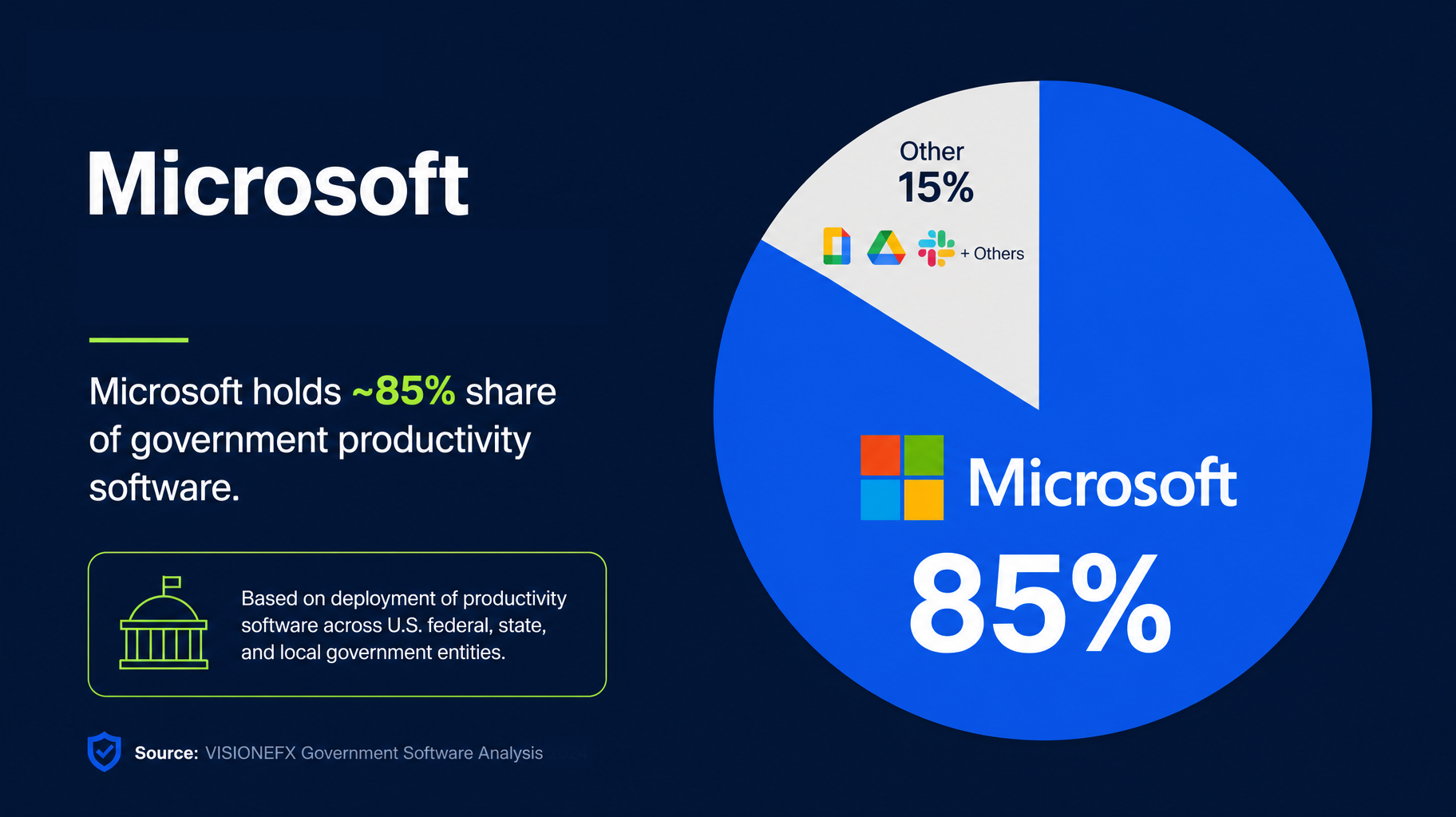
A market study by research firm Omdia found that Microsoft holds roughly 85% of the U.S. government office productivity software market—more than seven times the share of its next-largest competitor. Federal agencies run on Windows, Microsoft 365, SharePoint, Teams, and Azure. (Source: CCIA / Omdia study)
And that footprint is deepening. In late 2025, the General Services Administration announced its OneGov agreement with Microsoft — a multi-billion-dollar deal projected to save agencies more than $6 billion over three years on Microsoft 365, Azure, and notably, Microsoft Copilot licenses across the federal workforce. (Source: GSA newsroom)
Why does productivity software share translate into search behavior? Three reasons:
1. Edge is the standard browser.
After Internet Explorer’s retirement, Microsoft Edge became the default across most agency endpoints—and Edge ships with Bing as its default search engine.
2. Defaults are frequently locked.
On managed government devices, IT administrators can enforce browser and search-engine defaults through group policy and mobile device management. Many federal employees can’t install Chrome or change their search engine even if they want to.
3. Windows itself searches with Bing.
Queries typed into the Windows taskbar search box route to Bing regardless of browser settings. It’s hardwired into the operating system. The net effect: for millions of government employees, Bing is the path of least resistance — and often the only path — for a workday web search.
Bing’s Desktop Numbers Are Bigger Than You Think
“But nobody uses Bing” is the reflex objection — and it’s outdated.
As of mid-2026, Bing has reached an all-time high of roughly 10% of all U.S. search traffic, according to StatCounter-based tracking. More importantly for B2G marketers, Bing is overwhelmingly a desktop engine: its mobile share is well under 1%. In comparison, its U.S. desktop share runs between roughly 13% and 18% depending on the tracker and month.
Bing’s users are almost entirely desktop searchers during business hours
The exact profile of a government buyer at their workstation. Layer on the demographic data from Microsoft Advertising and SimilarWeb — Bing’s audience skews toward professionals, with roughly half of users in the top quartile of household income — and the picture sharpens further.
Now combine the two threads: Bing owns a meaningful double-digit slice of U.S. desktop search in general, and government desktops are disproportionately configured to default to Bing. Among government procurement professionals, Bing’s effective share is almost certainly well above the national average.
An honest caveat: no public dataset isolates exactly what percentage of government employees search on Bing. This is an inference built from Microsoft’s documented dominance in government IT, locked browser defaults, and Bing’s desktop-heavy usage pattern—not a surveyed statistic. But it’s a strong inference, and your competitors haven’t acted on it.
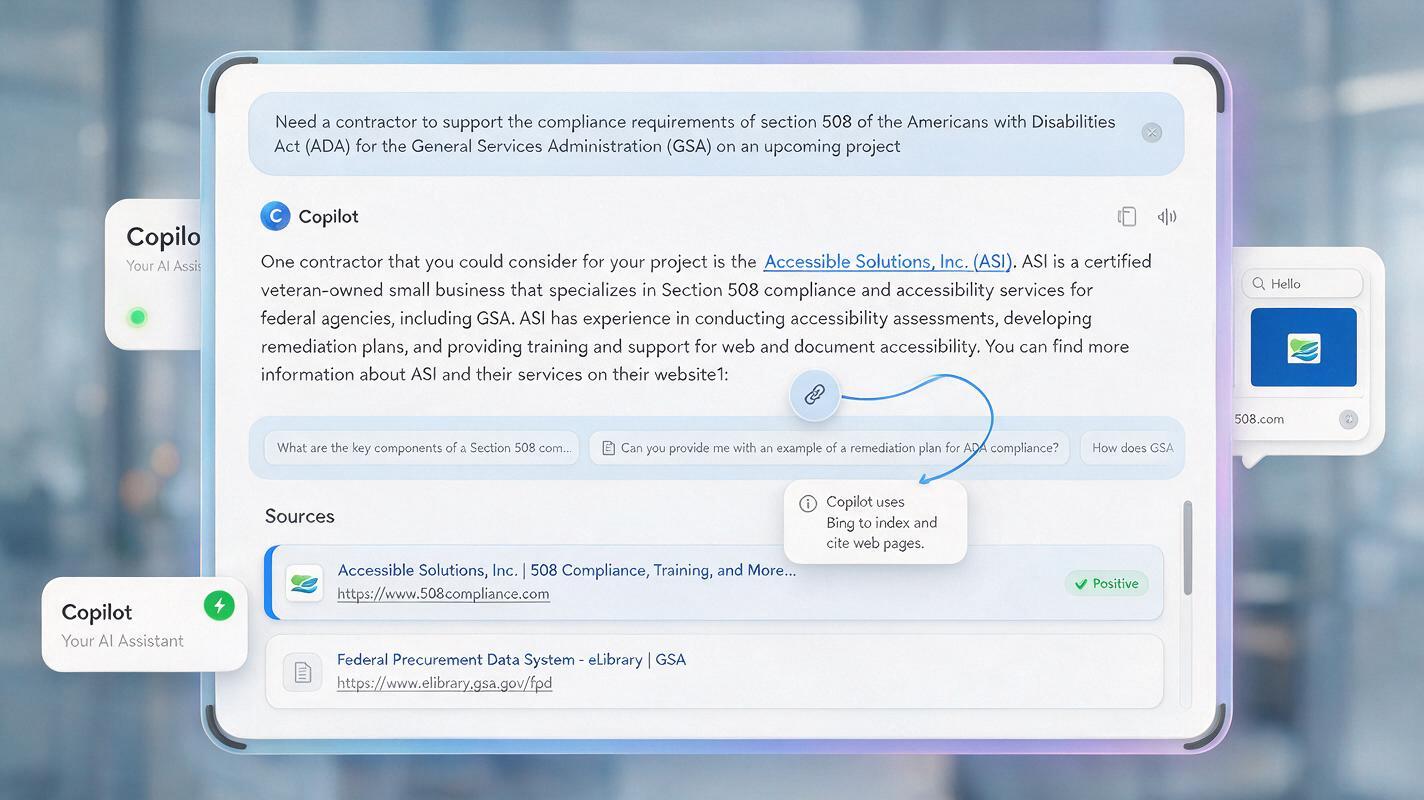
Here’s where this stops being a traditional SEO conversation and becomes a generative engine optimization (GEO) conversation.
Microsoft Copilot draws on Bing’s index to ground its answers.
When a federal employee asks Copilot to “find IT modernization vendors with FedRAMP experience” or “compare facilities maintenance contractors in Virginia,” the sources Copilot can see, parse, and cite come from Bing’s web crawl.
And Copilot is headed to government desktops at scale. The GSA’s OneGov agreement explicitly includes Copilot as part of moving the federal workforce into the AI era. That means the AI assistant inside the tools your buyers use every day answers questions from Bing’s view of the internet.
If your website isn’t indexed cleanly by Bing — or worse, if Bingbot can’t crawl it at all — you’re invisible in the AI answer layer, not just the search results page.
The good news: the tactics that win on Bing overlap heavily with the tactics that earn AI citations everywhere:
- Structured data (schema markup) that machines can parse without guesswork
- Clear, explicit language — stating plainly who you serve, what you do, and where
- Quotable facts and specifics — contract vehicles, certifications, NAICS codes, past performance
- Crawlability — content in HTML, not trapped behind JavaScript, with fast, clean pages
Optimize for Bing, and you’re simultaneously optimizing for Copilot — and building the same signals that ChatGPT, Perplexity, and Claude look for when deciding which companies to mention.
How Bing SEO Differs from Google SEO
- Bing and Google reward many of the same fundamentals, but Bing has its own personality. Key differences to know:
- Exact-match keywords carry more weight. Bing ranks more literally than Google’s semantic interpretation. If government buyers search “GSA Schedule holder web design Virginia,” those words should appear on your page — plainly.
- Schema markup is leaned on heavily. Bing has long encouraged structured data and uses it aggressively for rich results and entity understanding.
- Domain age and established authority matter. Bing tends to favor older, proven domains — an advantage for established contractors.
- Social and LinkedIn signals count. Microsoft owns LinkedIn, and LinkedIn content surfaces prominently in Bing results. For a B2G audience, a strong LinkedIn company presence is a Bing ranking asset.
- Multimedia is rewarded. Bing favors pages with relevant images and video — and indexes them well.
- Bing Places drives local visibility. For contractors serving specific regions or installations, a claimed and optimized Bing Places listing is the map-pack equivalent.
The B2G Bing Optimization Checklist
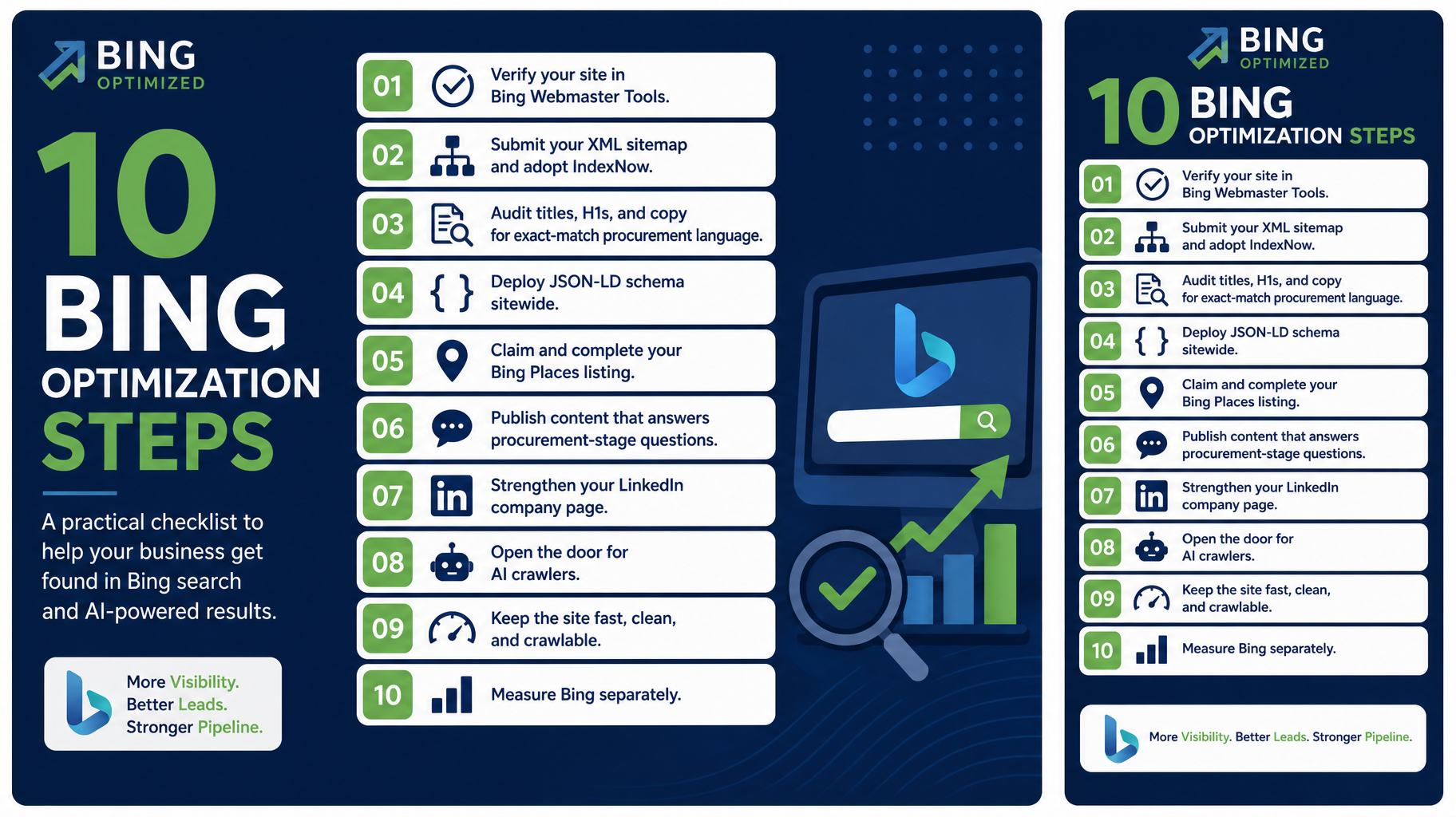
Here’s the practical playbook. Most of these items are low-cost, one-time setups — and almost none of your competitors have done them.
- Verify your site in Bing Webmaster Tools. You can import your verified sites directly from Google Search Console in a few clicks.
- Submit your XML sitemap and adopt IndexNow. IndexNow pushes new and updated URLs to Bing instantly instead of waiting on a crawl — a genuine speed advantage over Google indexing.
- Audit titles, H1S, and copy for exact-match procurement language. Work in the phrases buyers actually type: your NAICS codes, “capability statement,” contract vehicles, set-aside designations (SDVOSB, 8(a), WOSB, HUBZone), and the states or installations you serve.
- Deploy JSON-LD schema sitewide. At minimum: Organization, Service, and FAQPage markup — plus Article schema on your insights content.
- Claim and complete your Bing Places listing. Match your name, address, and phone exactly to your website and Google Business Profile.
- Publish content that answers procurement-stage questions. “How to evaluate [your service] vendors,” compliance explainers, past-performance case studies — the queries a contracting officer runs before a market research memo.
- Strengthen your LinkedIn company page. Complete your profile, post regularly, and encourage employee advocacy. It ranks in Bing and reinforces your entity.
- Open the door for AI crawlers. Confirm robots.txt allows Bingbot, and consider an llms.txt file plus explicit allowances for AI search crawlers so the generative layer can read your site.
- Keep the site fast, clean, and crawlable—server-rendered HTML content, compressed images, no critical copy locked inside JavaScript.
- Measure Bing separately. Segment Bing organic and Copilot referrals in your analytics so you can see the channel you’ve been ignoring.
Download: VISIONEFX-B2G-Bing-Optimization-Checklist
What This Means for Your Marketing Budget
To be clear: this isn’t an argument to abandon Google, which still handles most U.S. searches. It’s an argument for proportional coverage of where your specific buyers actually search.
For a B2G company, Bing optimization is one of the highest-leverage, lowest-cost moves available: a few hours of setup, a discipline of structured data and explicit copy, and a channel where the competition is thin and the audience is disproportionately made up of the exact people who sign your contracts.
FAQ
Do government employees really use Bing?
No public survey isolates government employees’ search-engine share. Still, the infrastructure evidence is overwhelming: Microsoft holds about 85% of the government productivity software market, Edge is the standard browser on agency machines, defaults are often locked by IT policy, and Windows taskbar searches route to Bing. Combined with Bing’s 13–18% share of U.S. desktop search overall, government buyers are disproportionately likely to be searching on Bing.
Should I stop optimizing for Google?
No. Google still commands most U.S. search traffic and remains essential. Bing optimization is an addition, not a replacement — and most of the work (schema, clear copy, fast pages) benefits both engines plus AI assistants.
Does Bing SEO help with AI search visibility?
Yes, directly. Microsoft Copilot grounds its answers in Bing’s index. Hence, Bing indexing is a prerequisite for appearing in Copilot responses — and Copilot is being rolled out across the federal workforce under the GSA’s agreement with Microsoft. The same structured-data and clarity signals also improve your odds of being cited by ChatGPT, Perplexity, and other AI assistants.
How is Bing SEO different from Google SEO?
Bing is more literal: exact-match keywords, structured data, domain authority, multimedia, and LinkedIn/social signals carry more relative weight. Google leans harder on semantic interpretation and link-graph nuance. The fundamentals — quality content, clean technical SEO, fast pages — win on both.
How fast will I see results on Bing?
Often faster than Google. IndexNow gets new pages into Bing’s index almost immediately, and competition for B2G keywords on Bing is thin. Many sites see measurable Bing impressions within weeks of proper Webmaster Tools setup and sitemap submission.
Ready to Get Found by Government Buyers?
VISIONEFX has been building search-optimized websites for businesses and institutions since 2000 — and today that means optimizing for Google, Bing, and the AI assistants your buyers ask for recommendations. If you sell to government agencies and your website has never been tuned for Bing or Copilot, you’re leaving visibility on the table.
Contact VISIONEFX for a Bing and AI-visibility audit of your website — we’ll show you exactly where you stand and what to fix first.