

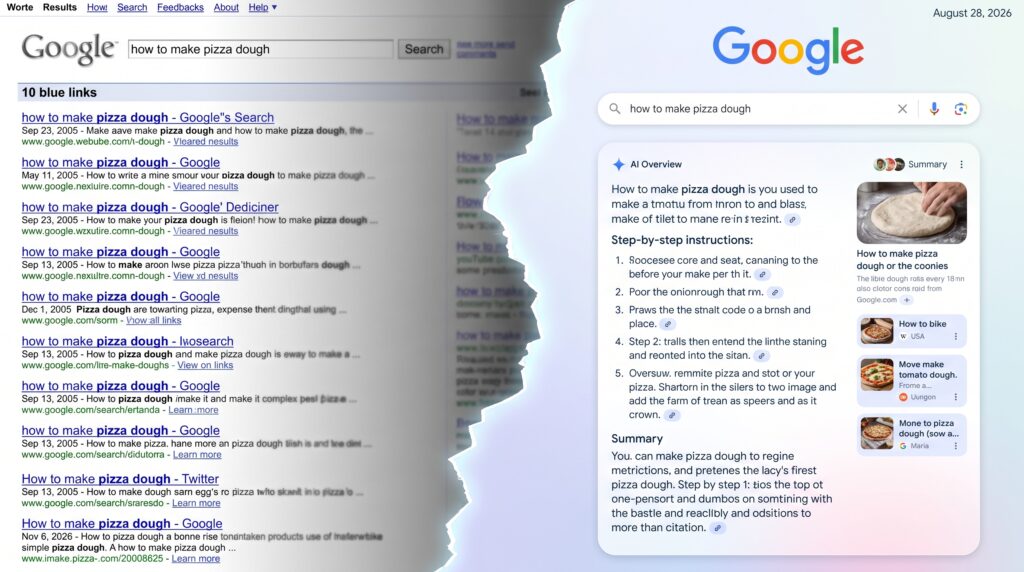
The 10 Blue Links Are Disappearing — and Google Is the One Retiring Them
For more than two decades, a Google search meant the same ritual: type a query, scan ten blue links, click one, evaluate, hit the back button, try again. That era is ending — not because search failed, but because the search engines themselves decided to end it.
If you own a business or manage a website, this is the most important shift in online visibility since Google itself launched. Understanding why it’s happening tells you exactly where your marketing needs to go next.
The Shift Is Already Here
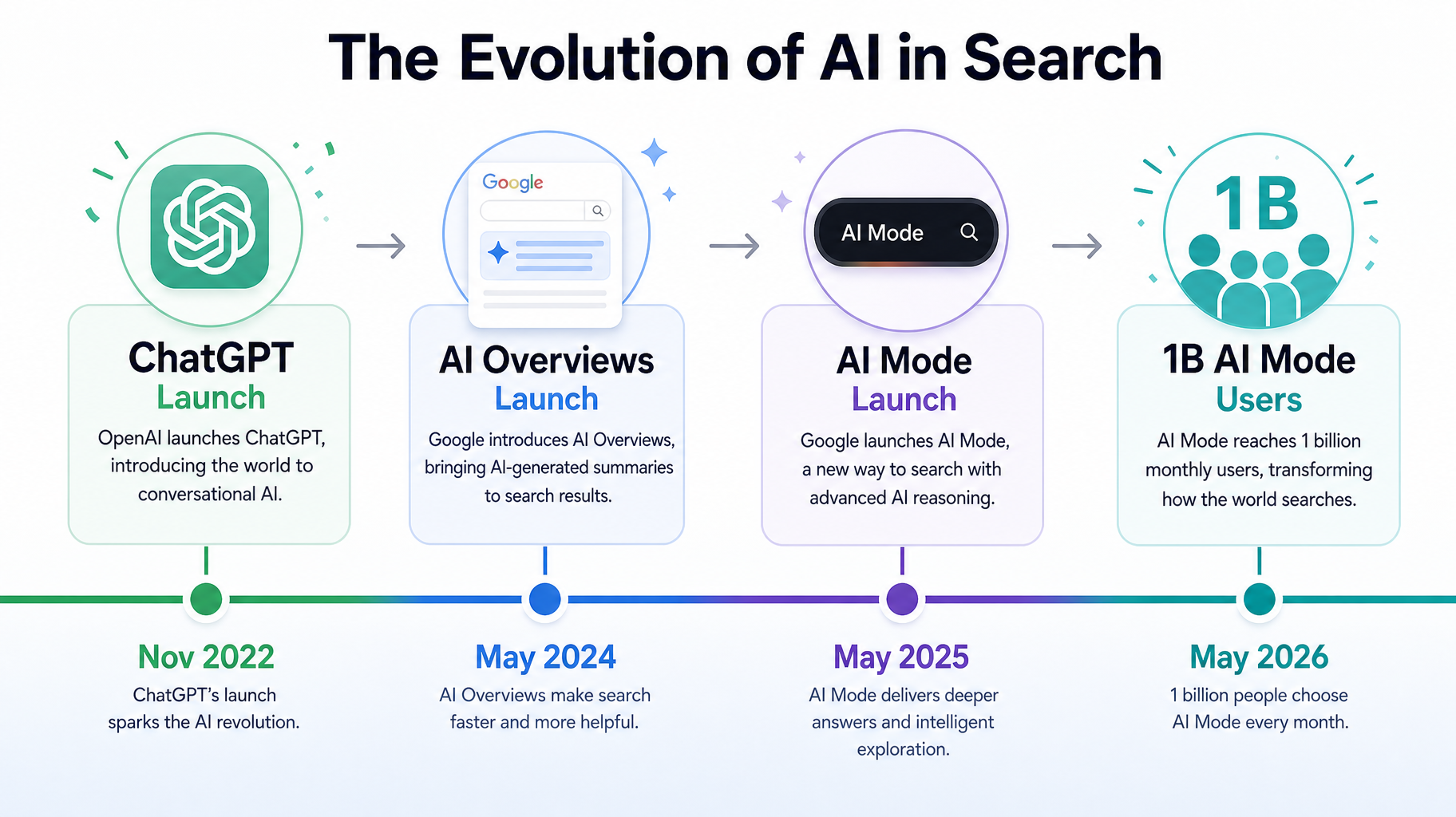
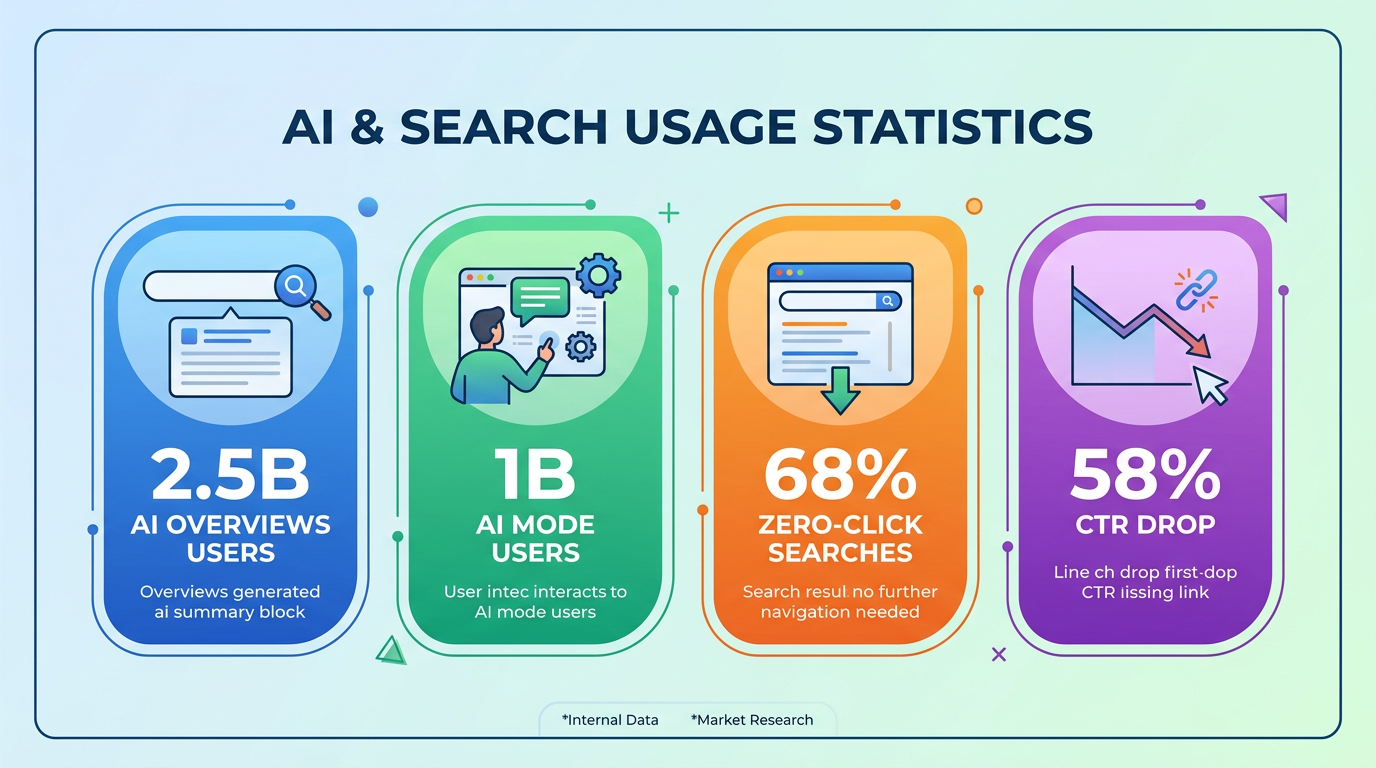 This is no longer an experiment running quietly in a lab. At Google I/O 2026, the company announced that AI Overviews — the AI-generated summaries that now sit above traditional results — reach more than 2.5 billion people every month across 200+ countries. AI Mode, the fully conversational search tab Google launched in May 2025, crossed 1 billion monthly users in roughly twelve months, with query volume doubling every quarter.
The behavioral data tells the same story from the user’s side. SparkToro’s 2026 clickstream study found that about 68% of U.S. Google searches now end without a single click to an outside website. And when an AI Overview appears on a results page, Ahrefs measured click-through rates for the #1 organic result dropping by as much as 58%.
The ten blue links haven’t been deleted. They’ve been demoted — pushed below an answer that satisfies most searchers before they ever scroll. Here’s why every major search engine is making that trade on purpose.
Reason 1: Users Never Wanted Links — They Wanted Answers
The ten blue links were never the product. They were a workaround for technology that couldn’t do what people actually came for: answer the question. For 25 years, search engines handed you a reading list and made you do the synthesis.
User behavior shows how ready people were to skip that homework. A Pew Research Center study of nearly 69,000 real queries found that when an AI Overview is present, only 8% of users click an organic result, versus 15% when there’s no AI summary. Just 1% click the citation links inside the AI answer itself.
The way people search is changing along with it. Google reports that queries typed into AI Mode run about three times longer than traditional searches, and roughly one in six now arrives as voice or images instead of text. When the interface can handle a real question, people ask real questions — multi-part, conversational, specific. Ten ranked documents were always a poor answer to “compare these three options for my situation and tell me which fits.” An AI synthesis is a good one.
Reason 2: Competitive Survival — the ChatGPT Effect
 Google didn’t make this shift in a vacuum. It made it under fire.
ChatGPT reached 1 billion weekly active users by August 2026. Pew found that 44% of U.S. adults have used it — and 61% of adults under 30, the demographic that defines where habits go next. By 2026, roughly 37% of consumers say they begin their searches with an AI tool rather than a traditional search engine.
The alarm bells inside Mountain View were public. In May 2025, Apple executive Eddy Cue testified in the Google antitrust case that searches in Safari had declined for the first time in over twenty years as users drifted toward AI assistants — and Alphabet’s stock dropped sharply on the news. Gartner had already forecast that traditional search engine volume would fall 25% by 2026 as AI chatbots absorbed query share.
Here’s the irony: Google invented the transformer architecture that powers modern AI back in 2017, then hesitated to aim it at its own golden goose. That’s the textbook innovator’s dilemma — protect the profitable old model, or disrupt yourself before someone else does. ChatGPT removed the choice. Google could either cannibalize the ten blue links itself or watch OpenAI, Perplexity, and Microsoft do it from the outside. It chose self-cannibalization, and every other engine followed.
Reason 3: The Economics Favor Answers, Not Exits
There’s a cynical read on this shift, and it’s worth stating plainly: every click to your website is a user leaving Google’s page. An AI answer keeps them there — on the surface where Google sells the ads.
The monetization is catching up fast. Industry tracking in early 2026 found ads appearing in roughly a quarter of AI-generated results, up nearly 400% year over year. And the “AI will kill Google’s business” thesis hasn’t held: Alphabet reported Search revenue up 19% to $60.4 billion in Q1 2026, with CEO Sundar Pichai noting that AI features are driving total query volume to all-time highs and that AI Overviews monetize at rates similar to traditional search.
Follow that math: more queries, comparable monetization per query, and more time spent on Google-owned surfaces. The ten links were never the business model — your attention was. AI answers concentrate more of it.
Reason 4: This Was Always the Destination
Google’s mission statement never said “rank web pages.” It said organize the world’s information and make it universally accessible and useful. Read that literally, and the ten blue links look like what they were: a 1998-era compromise with the technology of the day.
The breadcrumb trail has been visible for years. Knowledge panels arrived in 2012—featured snippets arrived in 2014. People Also Ask, local packs, direct answers for weather, sports, and flights — each one moved the answer onto the results page and made the click optional. Large language models didn’t change Google’s direction. They removed the last technical constraint.
What This Means for Your Website
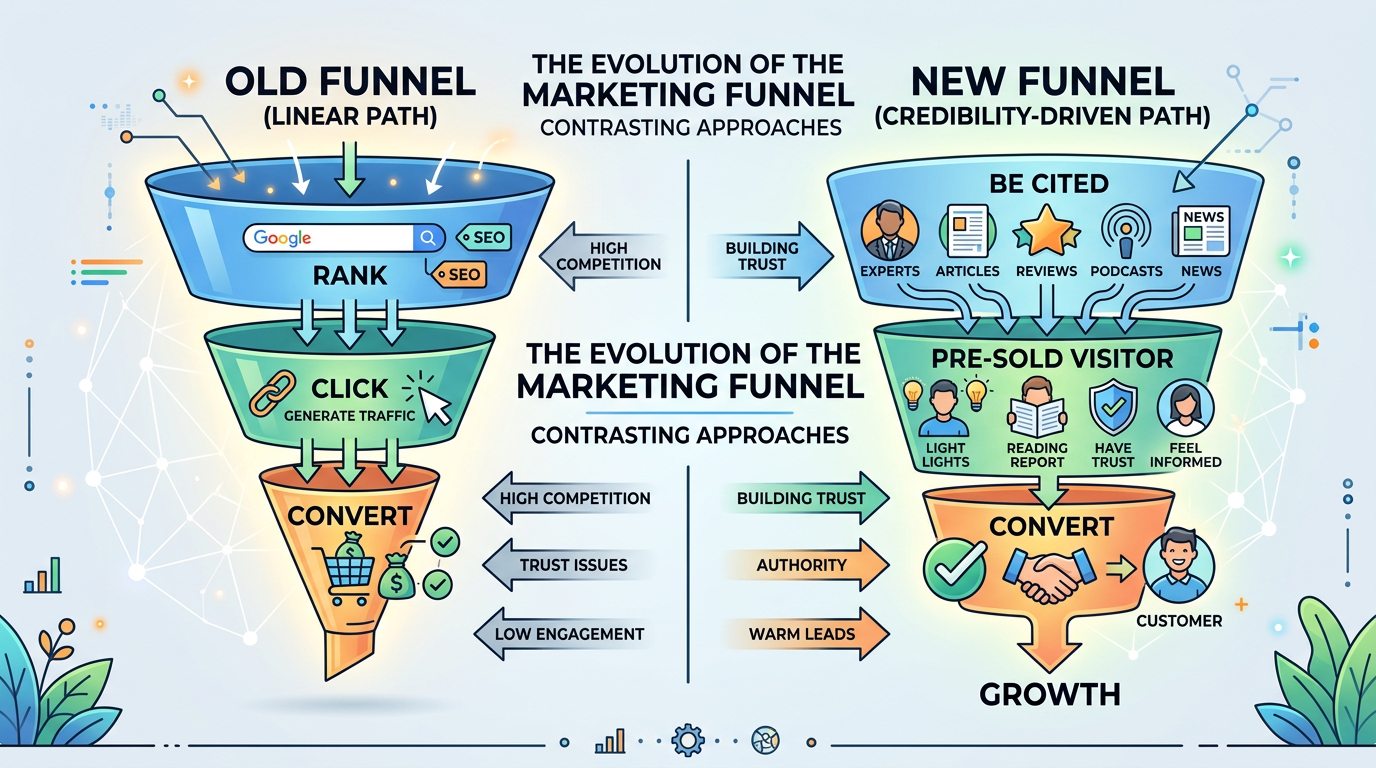 Here’s the part that should reframe your entire SEO strategy: ranking and being cited are becoming two different games. Ahrefs found that only 38% of pages cited inside AI Overviews still rank in Google’s organic top 10 — down from 76% just eighteen months earlier. You can rank #1 and be invisible in the answer, or rank #14 and be the source the AI quotes.
Winning in AI-driven search — call it generative engine optimization (GEO) or answer engine optimization (AEO) — means optimizing to be the source, not just a result:
Structure content to be quotable.
Lead with direct answers, use clear question-based headings, add FAQ sections, and implement schema markup so machines can extract your expertise cleanly.
Build entity authority.
AI systems recommend brands they can verify. That means a consistent name, address, and phone across the web; a complete Google Business Profile; strong reviews; and mentions on the sites AI models trust. Read: Steps to Optimize a Local Business for Search Results
Earn mentions, not just backlinks.
Digital PR, industry citations, and mentions in trusted publications now influence AI answers the way links once influenced rankings.
Track your AI visibility.
You measure rankings; start measuring whether ChatGPT, Gemini, Perplexity, and AI Overviews mention your brand when customers ask the questions you want to win.
Read the Pew Research Center AI Overviews click study.
Diversify beyond the click.
Email lists, communities, and direct traffic are the assets no algorithm can summarize away.
One reassurance backed by early data: fewer clicks doesn’t automatically mean fewer customers. Visitors who arrive from an AI answer have often already been “pre-sold” by the summary and tend to convert at higher rates. The funnel isn’t dying — it’s moving upstream, into the answer itself.
FAQ
Are the 10 blue links going away completely?
Not overnight. Classic organic results still appear beneath AI Overviews, and AI Mode remains a separate tab — for now. But with AI Mode queries doubling every quarter and Google testing AI-first layouts, the traditional results page is becoming the fallback experience rather than the default one.
What’s the difference between AI Overviews and AI Mode?
AI Overviews are AI-generated summaries that appear at the top of a standard results page, above the links. AI Mode is a fully conversational search experience — a chat-style tab where Google’s Gemini models answer complex, multi-part questions using a technique called query fan-out, running many searches behind the scenes to build one synthesized answer.
Does traditional SEO still matter?
Yes — it’s the foundation, not the whole house. AI answers are grounded in crawled, indexed, well-structured content, so technical SEO, quality content, and authority still determine which sources the AI can draw from. What’s changed is the goal: you’re optimizing to be cited in the answer, not just positioned on a page.
How do I get my business mentioned in AI search results?
Focus on clear, factual, well-structured content that directly answers customer questions; robust schema markup; consistent business information across the web; genuine reviews; and mentions in publications AI systems treat as authoritative. Then test it — ask the major AI tools the questions your customers ask, and see who gets recommended.
Should I expect my organic traffic to drop?
If informational queries drive most of your traffic, some decline is likely as AI answers absorb those clicks. The strategic response is to measure what matters — qualified visits, leads, and AI citations — rather than raw sessions, and to strengthen the channels you own.
The Bottom Line
The ten blue links aren’t dying because search broke. They’re dying because search can finally do what it always intended: deliver the answer, not the reading list. Google, Bing, and the AI-native engines have all placed the same bet, and the user numbers say it’s paying off.
For businesses, the question is no longer “where do we rank?” It’s “are we in the answer?” The brands that adapt now — structuring their content for machines, building verifiable authority, and tracking their AI visibility — will own the next decade of search the way early SEO adopters owned the last one.
Want to know how your business shows up when AI answers your customers’ questions? Request an AI visibility audit — we’ll show you exactly where you stand.