

There’s No Autopilot for Google or AI Search: What It Really Takes to Get Found in 2026
The short answer: Ranking on Google and getting mentioned by ChatGPT, Gemini, or Perplexity isn’t a one-time task. It’s more like physical fitness than a vaccination. A good checklist, even a great one from an AI tool, gets you to the starting line. What keeps you visible is ongoing work: measuring what’s happening, adjusting pages, publishing new content, keeping your business listings accurate, and having an experienced person read the results and make judgment calls that software can’t.
“I Asked ChatGPT, and It Gave Me a Complete Plan”
We hear some version of this every week. A business owner asks ChatGPT or another AI assistant something like “Give me everything I need so my website ranks #1 on Google and shows up in AI search.” A few seconds later, they have an impressive, confident list: page titles, H1 and H2 tags, meta descriptions, keywords, schema markup, page count, word count, internal links.
Sometimes they bring that list to us. Sometimes they hand it to another developer or build the site themselves. Then, a few months later, the question comes: “We did everything on the list. Why aren’t we showing up?”
The honest answer isn’t that the list was wrong. Most AI-generated checklists are reasonably accurate on the basics. The problem is what the list quietly implies: that there’s a finish line. That if you check every box once, Google and AI will reward you from then on.
This article is meant to clear up that myth.
What the AI Checklist Gets Right
Let’s give credit where it’s due. A typical AI checklist covers real, useful things: clear page titles, one main heading per page, descriptive subheadings, a sensible page structure, a fast and mobile-friendly site, and content that answers customer questions.
Those matter. Starting a website without them puts your site at a disadvantage.
But notice what all of those have in common: they’re things that happen on your website, one time. They describe how to build the car. They say nothing about fueling it, driving it, maintaining it, or noticing when a tire is going flat.
What the Checklist Can’t Do
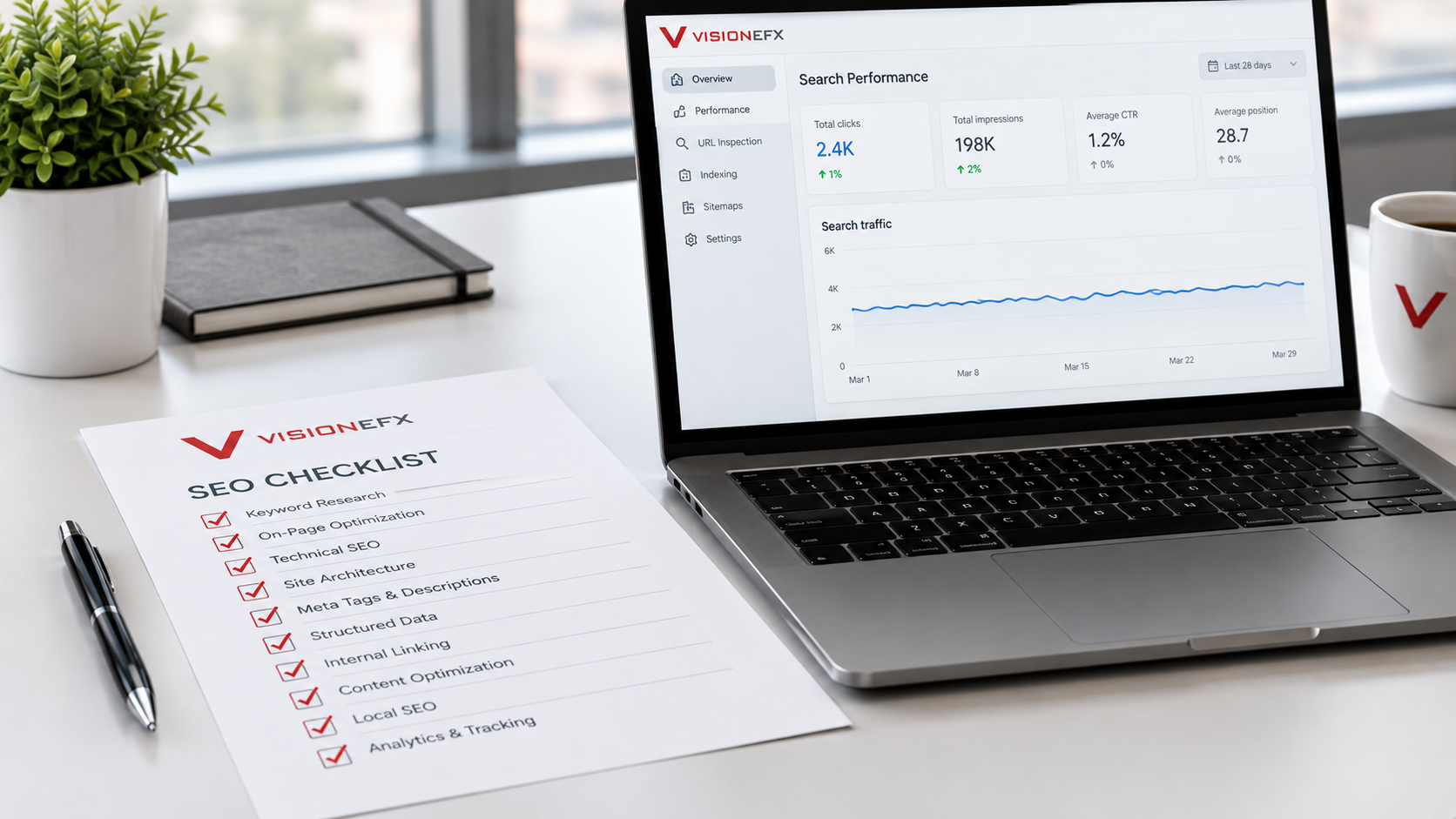 An AI checklist has some built-in blind spots that aren’t anyone’s fault. They’re just the nature of a generic answer.
It doesn’t know your competitors. Ranking is relative. You’re not being graded on a fixed test; you’re being compared to every other business trying to rank for the same thing in your area. A plumber in Virginia Beach and a plumber in rural Montana could follow the identical checklist and get completely different results.
It can’t see your data. It doesn’t know which pages Google has actually indexed, which searches you already appear for, what people click, or where visitors leave. Without that, every recommendation is a guess.
It doesn’t know what changed last month. Google updates how it ranks pages many times a year. The AI assistants change how they choose sources even more often. A checklist is a snapshot, and the ground keeps moving.
It can’t make judgment calls. Should you combine two thin pages into one strong one? Is that sudden traffic drop a technical problem, a seasonal dip, or a competitor’s new page? Is a keyword worth chasing, or is it a dead end? Those decisions take experience, not a template.
The Real Moving Parts (and What Each One Does)
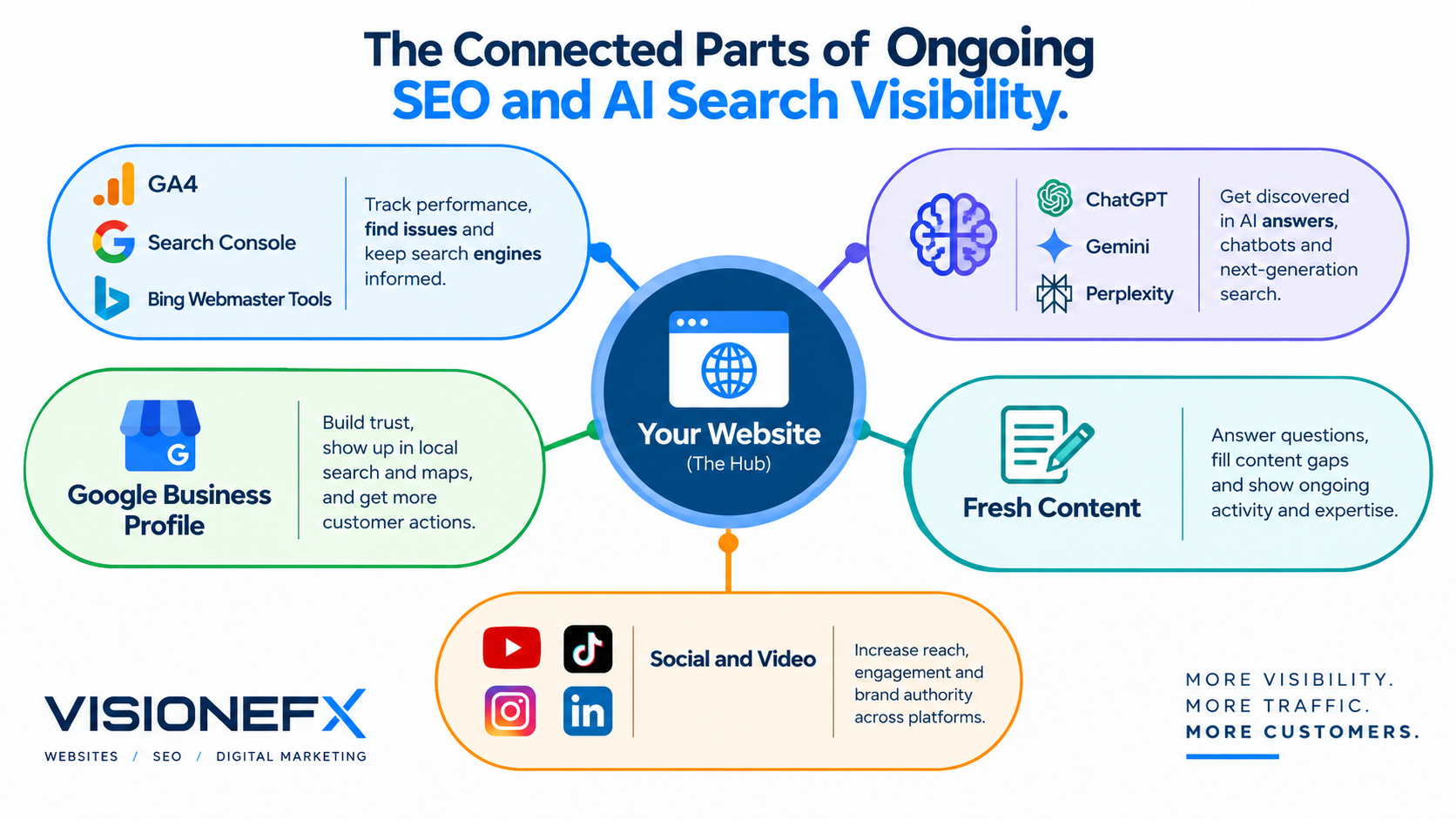 Here’s the part most people never see. Getting found online is made up of several connected pieces, and each one needs attention over time.
1. Your Website Itself
This is the foundation the checklist covers: structure, headings, speed, mobile layout, security, and clear content. But even this isn’t “done” at launch. Plugins update, pages break, content goes stale, and new services need new pages. We cover this in more detail in Why Your Website Needs Regular ‘Tune-Ups’.
2. The Measuring Tools: Google Analytics, Google Search Console, and Bing Webmaster Tools
Think of these as your dashboard gauges. Without them, you’re driving at night with the headlights off.
Google Analytics (GA4) tells you what visitors do once they arrive: how they found you, which pages they read, and whether they called, filled out a form, or left.
Google Search Console tells you how Google sees your site: which pages are indexed, which searches you appear in, how often people click, and whether Google has found errors it wants fixed.
Bing Webmaster Tools does the same job for Bing, and this matters more than most people realize, because Bing’s search results help feed ChatGPT’s answers. If Bing can’t find or trust your pages, you’re at a disadvantage in AI search too. More on that in Bing Is Feeding ChatGPT: Why Bing SEO Matters in 2026.
These tools don’t fix anything on their own. They produce reports. Someone has to read those reports, understand what they mean, and act on them every month.
3. AI Search: ChatGPT, Gemini, Perplexity, Copilot, and Google AI Overviews
AI assistants don’t have a magic list of “approved” businesses. For current information, they mostly search the web, pick sources they trust, and summarize what they find. That means AI visibility is built on top of regular search visibility, plus a few extra factors: clear, direct answers on your pages, consistent information about your business across the web, and a reputation that shows up in more places than just your own site.
We explain the mechanics in How AI Citations Work: The 3 Gates of AI Search Visibility. The key point: AI answers change constantly. You can be mentioned one week and missing the next. Checking regularly how AI tools describe your business, and correcting what’s wrong or missing, is now part of the job.
4. Your Google Business Profile
For any business that serves a local area, your Google Business Profile (the listing with your map pin, hours, photos, and reviews) is often seen by more people than your website. It needs fresh photos, posts, accurate hours, answers to questions, and a steady flow of genuine customer reviews that you respond to. Your name, address, and phone number also need to match everywhere they appear online, which we cover in NAP Consistency in 2026.
5. Fresh Content
Search engines and AI tools favor businesses that show they’re active and knowledgeable. That means publishing useful articles, answering the questions your customers actually ask, and updating older pages when information changes. One burst of blog posts at launch doesn’t carry a site for years. See Does Fresh Content Help with Ranking?
6. Social Networks and Video: LinkedIn, Facebook, YouTube, and More
Social media isn’t a direct ranking switch, but it does three important things. It sends real visitors to your content. It gets your name mentioned in places beyond your own website, which AI tools notice. And it builds the kind of recognition that makes people search for you by name.
YouTube deserves special mention. Google owns it; it’s one of the most-used search engines in the world, and short, helpful videos that answer customer questions can show up in Google results, AI answers, and YouTube itself. Posting your articles to LinkedIn and Facebook, and turning key topics into short videos, multiplies the value of every piece of content you create.
Why SEO and AI Visibility Never Stop
If there’s one idea to take away, it’s this: everything around your website keeps changing, even when your website doesn’t.
- Google adjusts its ranking systems.
- AI tools change which sources they trust.
- Competitors publish new pages and collect new reviews.
- Customers start searching with different words.
- Plugins and themes update and sometimes break things.
- Your own business adds services, changes hours, or moves.
A website that was perfectly optimized in January can quietly slide by summer without a single change. That’s not failure. It’s simply how search works.
Why an Experienced SEO Professional Still Matters
 AI tools are genuinely useful. We use them every day in our own work. But there’s a difference between a tool that produces recommendations and a professional who knows which recommendations to follow, which to ignore, and what to do when the numbers don’t add up.
An experienced SEO professional reviews the data, spots problems early, prioritizes the work that actually moves results, rewrites and tightens content, fixes technical issues, and keeps adjusting as Google and AI search change. Think of an AI checklist as a workout plan printed off the internet, and a good SEO partner as the trainer who watches your form, notices what’s working, and changes the plan when you plateau.
No autopilot program exists for ranking on Google or being cited by AI. Anyone selling one is selling a checklist in a nicer box.
What an Ongoing SEO and AI Search Plan Looks Like
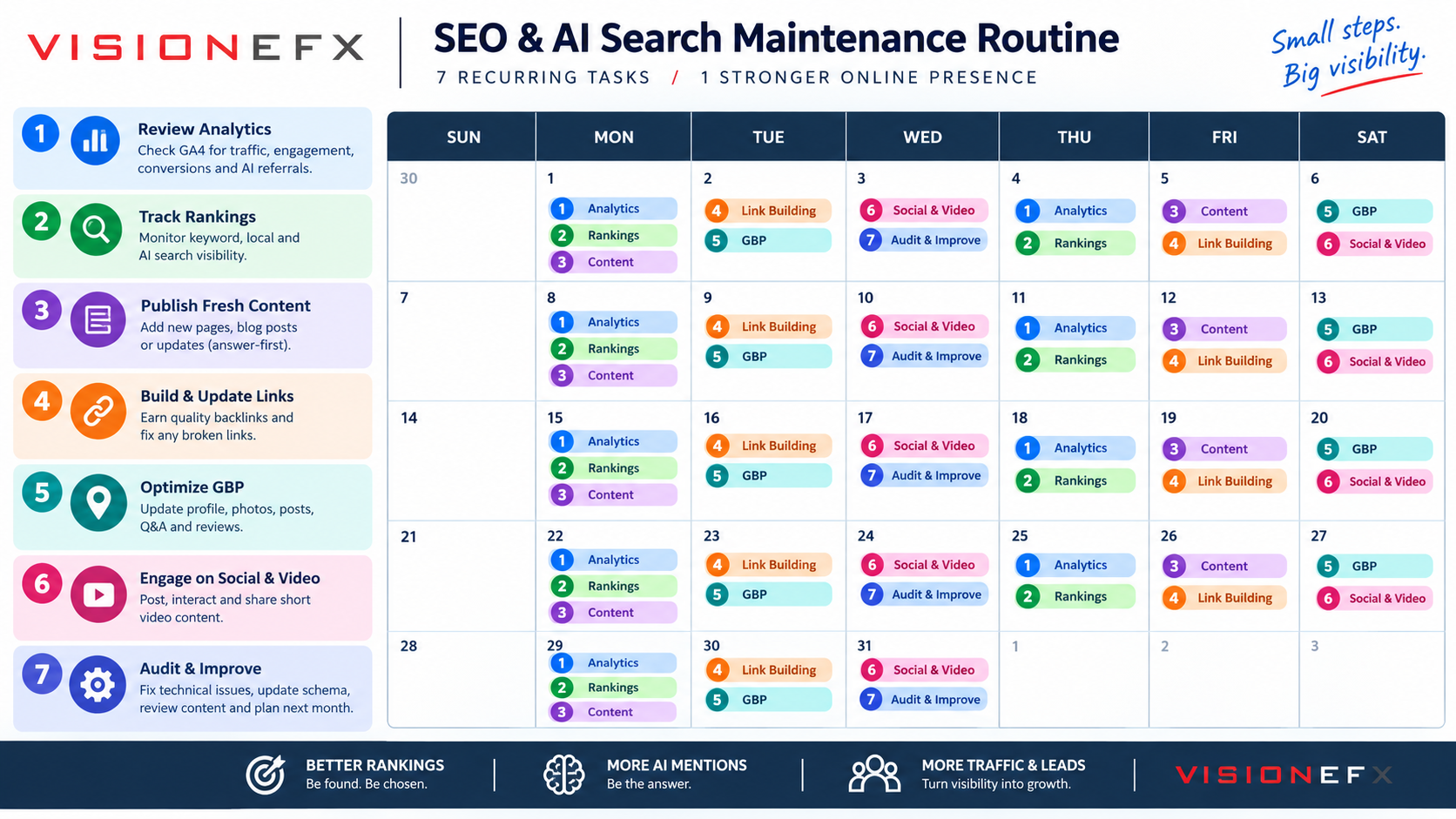
A realistic month of SEO and AI-search care usually includes:
- Reviewing Google Search Console, Bing Webmaster Tools, and Google Analytics for errors, drops, and new opportunities.
- Updating or improving a few existing pages.
- Publishing at least one new, genuinely useful piece of content.
- Sharing that content on LinkedIn, Facebook, and YouTube where it fits.
- Keeping the Google Business Profile active with posts, photos, and review responses.
- Checking how ChatGPT, Gemini, Perplexity, and Google’s AI Overviews describe your business.
- Keeping plugins, security, and site speed in good shape.
None of that is glamorous. All of it adds up.
FAQ
If I follow an AI-generated SEO checklist, will my site rank?
It will help your site start on solid footing, but a checklist alone rarely produces lasting rankings. Results depend on your competition, your content, your reputation across the web, and ongoing adjustments based on real data.
How long does SEO take to work?
Most businesses see meaningful movement in three to six months, depending on competition and where the site is starting from. It then takes continued effort to hold and grow those positions.
Can I just do SEO once and be done?
No. Search engines, AI tools, and competitors all change constantly. Sites that stop being maintained tend to lose ground gradually, even if nothing on them breaks.
Do I need to do anything special for ChatGPT and AI search?
Yes, but it builds on regular SEO rather than replacing it. Being well-indexed on Google and Bing, having clear answers on your pages, and keeping your business information consistent across the web are the foundation.
Is social media part of SEO?
Indirectly. Sharing content on LinkedIn, Facebook, and YouTube drives visitors, earns mentions, and builds name recognition, all of which support how search engines and AI tools view your business.
The Bottom Line
Using ChatGPT to create an SEO plan isn’t a mistake. It’s a smart first step, and it shows you’re taking your online presence seriously. Just know that the plan is the beginning of the work, not the end of it. Getting found on Google and cited by AI comes from steady, informed attention over time, guided by someone who reads the data and knows what to do with it.
If you’ve got an AI-generated checklist, or a site built from one, and you’re wondering why the results aren’t there yet, send it our way. We’ll review it with you and tell you honestly what’s working, what’s missing, and what it would take to move forward.