

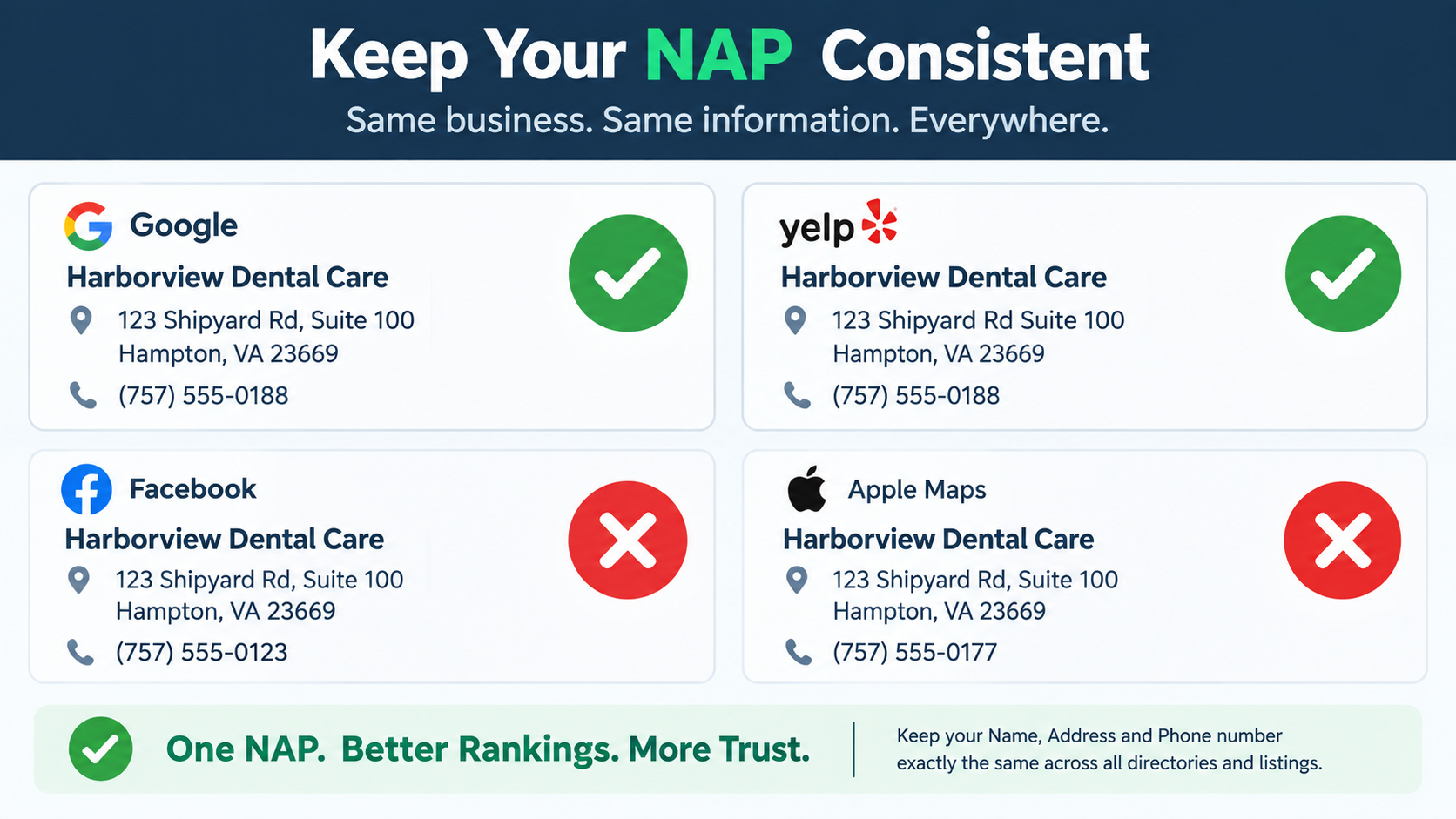
NAP Consistency in 2026: The Comma Question, What Actually Breaks Your Listings, and Why AI Raised the Stakes
The short answer: NAP consistency — keeping your business Name, Address, and Phone number aligned everywhere you appear online — matters more in 2026 than it did a decade ago. But not for the reason most articles claim. A comma won’t sink you; modern search engines normalize punctuation and standard abbreviations. What sinks you is materially conflicting data: an old address, a second phone number, a name that shifts from listing to listing. And the audience reading your citations is no longer just Google’s local algorithm. It’s AI assistants that recommend almost nobody, repeat whichever version of your data they happen to find, and state it with total confidence.
Let’s take those one at a time — starting with the comma.
The Comma Question, Answered Honestly
Here’s the claim you’ve probably read a dozen times: one listing writes your address with a comma, another without, and search engines treat that as an inconsistency that damages your rankings.
That was the working assumption in local SEO for years, and plenty of articles still repeat it. It’s no longer accurate. Search engines have gotten substantially better at recognizing minor formatting variations — “Street” versus “St.” and “Suite” versus “Ste.” can generally be normalized without harming your rankings. Google’s entity matching is built to fuzzy-resolve exactly this kind of noise: “123 Main Street” and “123 Main St” typically resolve to the same address.
But fuzzy matching has hard limits, and this is where the comma myth hides a real truth. “123 Main Street” and “125 Main Street” will not resolve to the same address — even though a human instantly recognizes the typo. And every formatting variation, while individually harmless, adds a little processing friction to how machines match your listings. The issue isn’t any single comma. It’s cumulative trust.
So here’s the practical rule we give clients: **being identical is free, so be identical. ** **** Pick one canonical format for your name, address, and phone number, and use it everywhere without exception. Not because a comma will tank you — it won’t — but because a strict standard costs nothing, removes all friction, and makes the genuinely dangerous inconsistencies impossible to introduce in the first place.
What Actually Breaks Your Business Entity
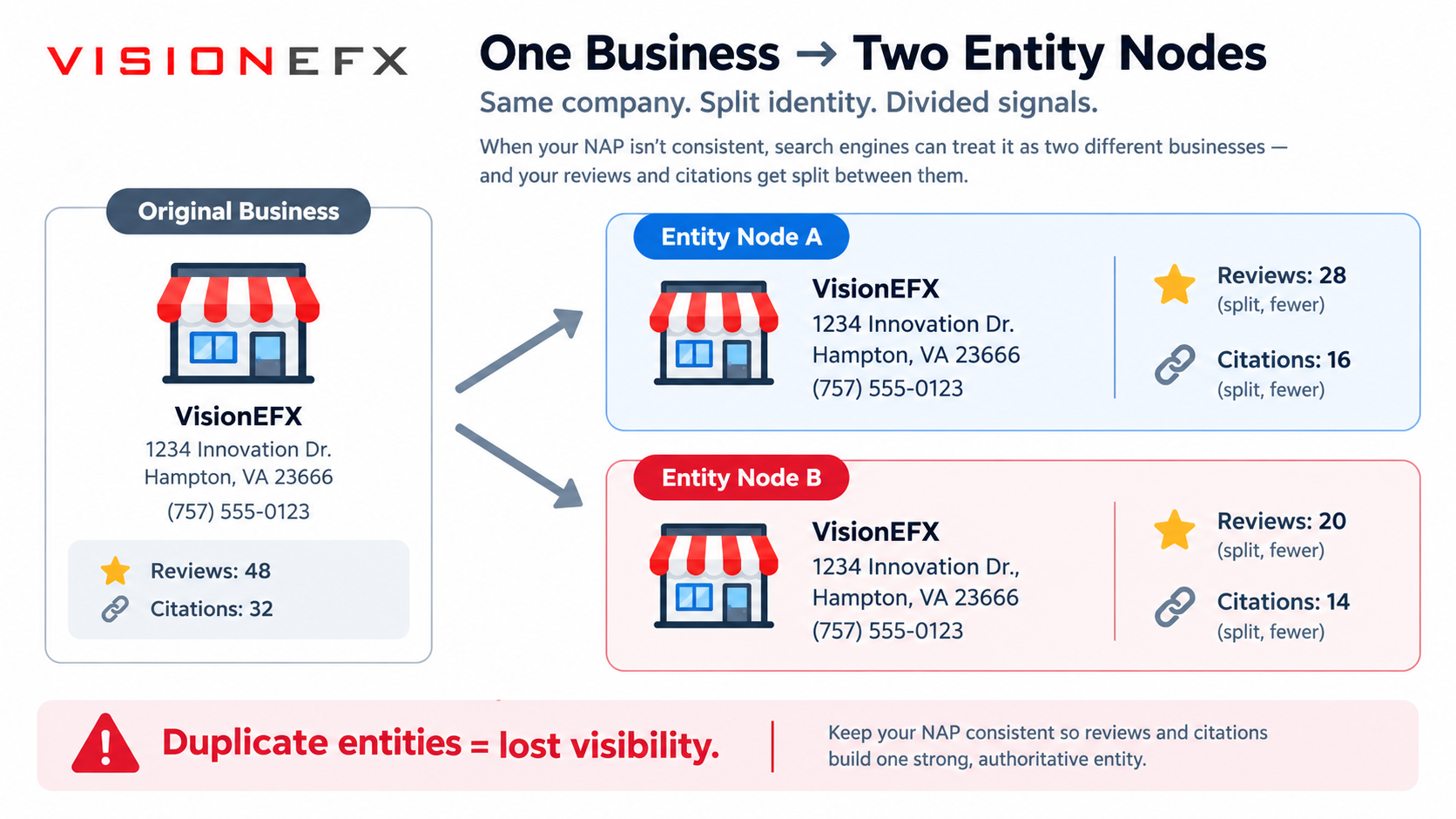 If punctuation isn’t the threat, what is? Material conflicts — cases where the *information* differs, not just the formatting. These are the inconsistencies that suppress local rankings and confuse the machines building a profile of your business:
- An old address that outlived your move. Outdated listings from a previous location are among the most damaging citation problems, because Google may surface that stale information in local results without you ever knowing. Directories scrape each other, so one fossil listing quietly reproduces.
- Multiple phone numbers in the wild. Minor format differences in a phone number are small friction. Entirely different numbers across major directories — usually the fallout of call-tracking numbers pasted where they don’t belong — can significantly suppress your Local Pack visibility. A machine can’t tell a tracking line from a wrong number.
- A business name that won’t hold still. “Johnson Marketing” here, “Johnson Marketing Agency Inc.” there, “Johnson Marketing | Best SEO in Denver” on a third. Name variations weaken entity matching, and keyword-stuffed names now get flagged as untrustworthy by both Google and AI systems.
- Duplicate listings. When a citation conflicts sharply enough with your established profile, Google may create a *second entity node* for your business — splitting your reviews, citations, and authority across two identities. This is the worst-case outcome of inconsistency, and it happens more often than owners realize.
The stakes aren’t abstract. In a BrightLocal consumer panel, 62 percent of consumers said they’d avoid a business after finding incorrect information about it online. Wrong data doesn’t just confuse algorithms — it sends customers to your competitor’s front door.
The 2026 Stakes: AI Is Reading Your Citations Out Loud
 Everything above was true five years ago. Here’s what changed — and why we’d argue NAP discipline just graduated from ranking tactic to business insurance.
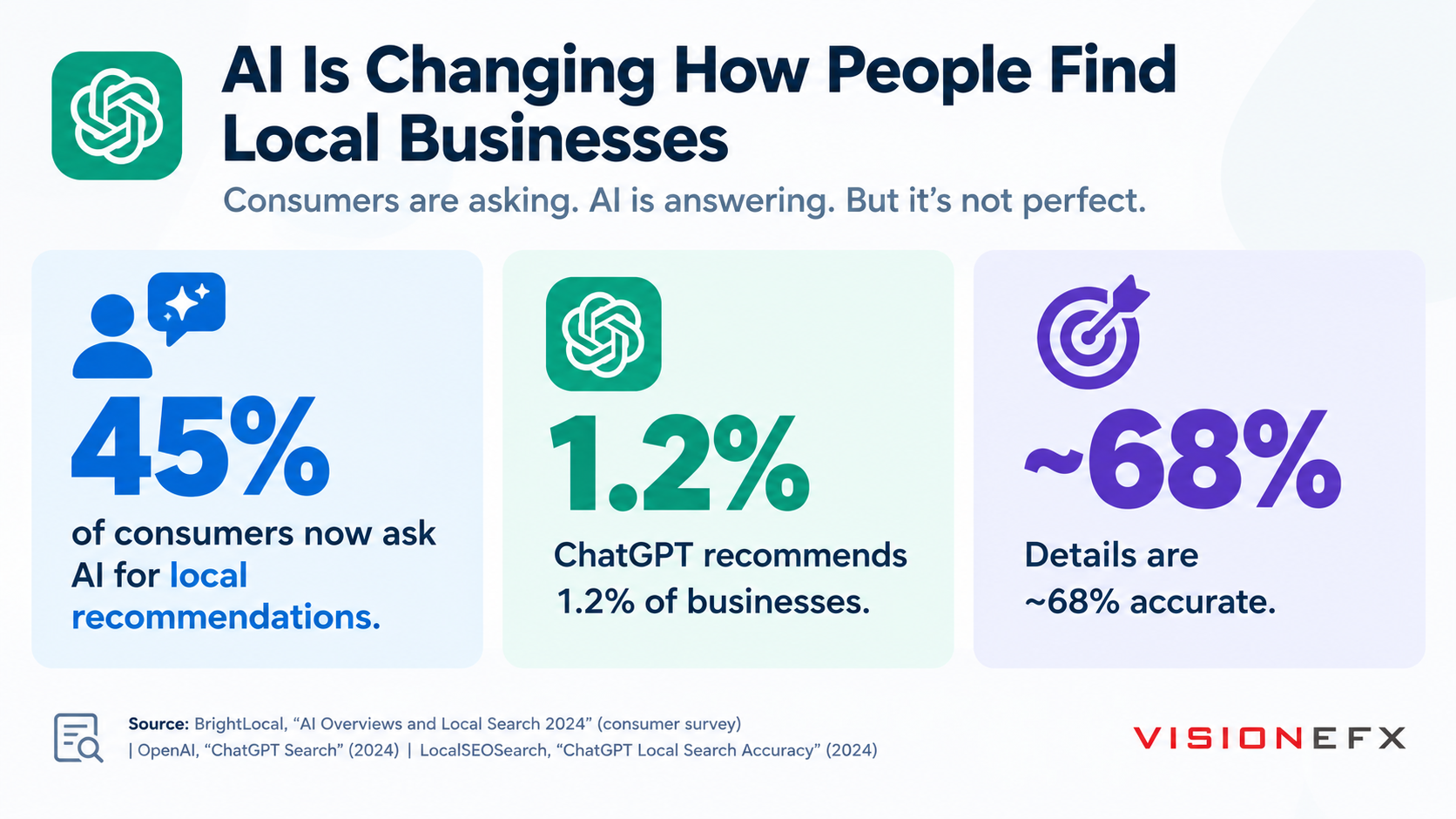
Consumers moved first. BrightLocal 2026 Local Consumer Review Survey found that 45 percent of US consumers used AI tools to find local business recommendations in the past year — up from 6 percent the year before. That’s not growth; that’s a channel materializing in twelve months. And 63 percent of those AI users trust the recommendations they get.
Now look at what those assistants are actually saying. SOCi 2026 Local Visibility Index, which analyzed more than 350,000 locations across 2,751 multi-location brands, found ChatGPT recommended just 1.2 percent of locations — versus a 35.9 percent average appearance rate in Google’s local 3-pack. Perplexity recommended 7.4 percent, Gemini 11 percent. AI doesn’t show ten blue links and let the customer choose. It names two or three businesses it trusts, and everyone else is invisible.
Accuracy is the other half of the problem. The same research measured business details at only about 68 percent accuracy on ChatGPT and Perplexity. A separate 2026 study of 250 companies found AI assistants confused 5 percent of businesses with entirely different companies and omitted important products or services in 28 percent of responses. When an assistant answers a phone-number question, it leans heavily on third-party sites — not your website — which means it recites whichever version of your data the citation ecosystem serves up.
Two details in that ecosystem deserve your attention:
– ChatGPT leans on sources you forgot existed. Analysis of ChatGPT’s local recommendations found a majority of its first-surfaced businesses trace back to Foursquare’s Places API — a dataset most owners last thought about a decade ago. Your Foursquare listing is suddenly load-bearing.
– Bing is ChatGPT’s map of the world. As we covered in our article on how AI citations work, ChatGPT and Copilot retrieve through Bing — which makes Bing Places the most neglected high-leverage listing in local search. We’ve spent enough hours in Bing Places troubleshooting for clients to say this plainly: most businesses have never claimed it, and it’s feeding answers every day.
And here’s the part that should genuinely worry you: when an AI assistant tells a customer the wrong phone number or says you’re closed, you see *nothing* on your end—no missed click in analytics, no ranking drop, no notification. There’s no login for ChatGPT, no field to correct, no form to submit. Your only lever is upstream — making the sources AI reads agree with each other. That’s NAP consistency. It’s the same entity corroboration we described as Gate 3 of AI visibility, operating at street level.
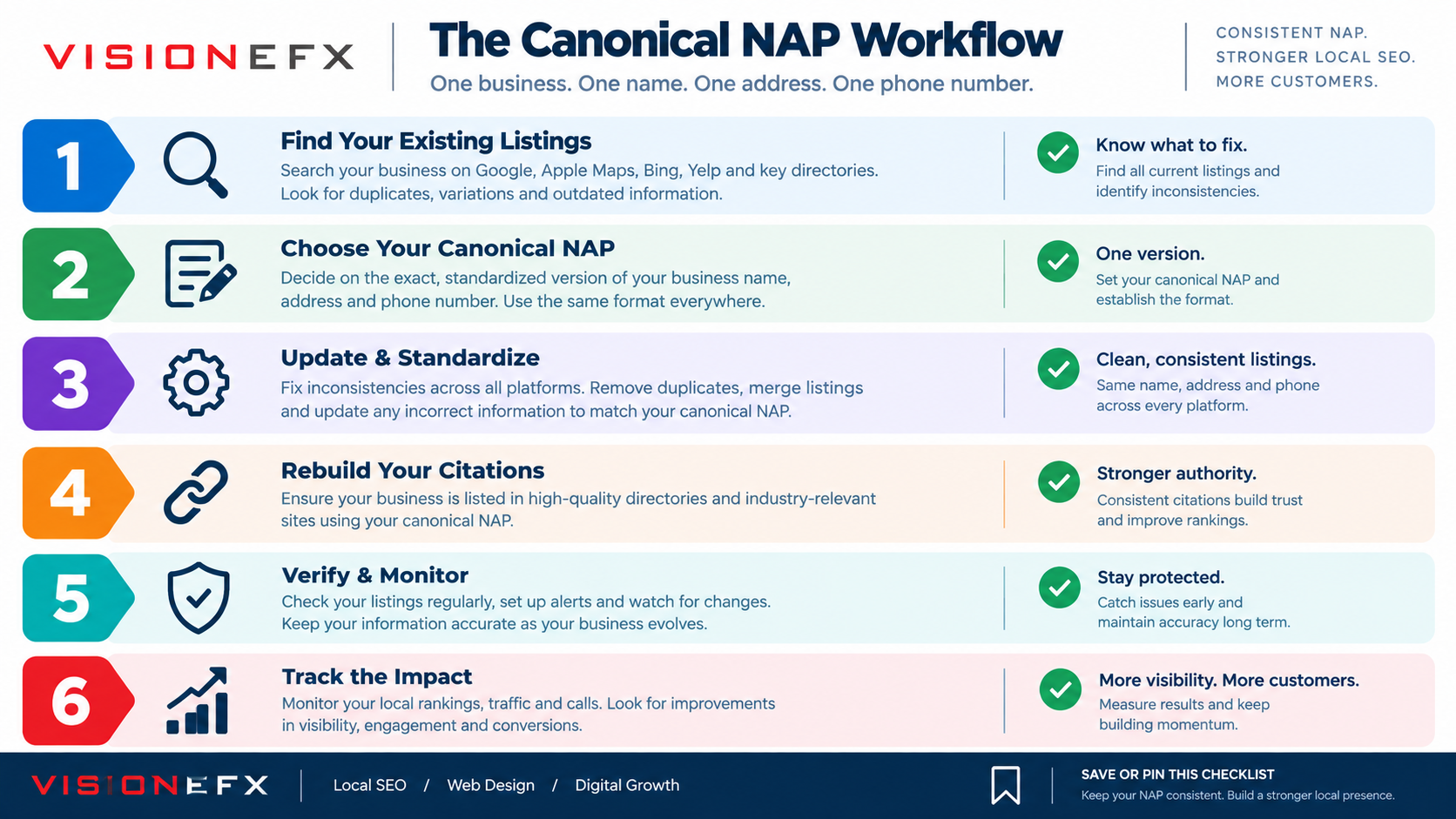
The Canonical NAP Workflow
Here’s the sequence we run for client rosters. It works because it fixes sources in the order machines trust them.
- Write the master record. One document: exact business name (matching your signage and legal filings — no keywords bolted on), one address format including suite conventions, one primary phone number. This is your single source of truth. Every listing matches it character for character from now on.
- Fix what you own first. Website footer, contact page, and — critically — LocalBusiness schema markup on your site. Schema is the machine-readable version of your identity, and it’s the one citation you fully control.
- Claim the big four. Google Business Profile, Bing Places, Apple Business Connect, and Facebook. These are the highest-authority sources search engines and AI systems check first.
- Feed the AI’s favorite databases. Foursquare, Yelp, and the major data aggregators (Data Axle, Foursquare’s distribution network) that syndicate your info to hundreds of smaller directories. Fix the aggregators, and the long tail largely fixes itself.
- Claim, correct, and kill. For every straggler directory with wrong data: claim the listing first so you control it, correct it to the master record, and request removal of any duplicate profiles before they mature into a second entity.
- Handle tracking numbers correctly. Keep your primary number in all listings and use dynamic number insertion on your own site for campaign tracking. Because insertion runs in JavaScript — which most crawlers skip — machines still see your canonical number in the raw HTML while your call tracking keeps working. It’s one of the few times JavaScript’s invisibility to bots works in your favor.
Maintain It Like It Matters — Because Now It Does
 NAP consistency was never a one-time project, but the maintenance cadence just tightened. A quarterly listings check made sense in 2024. In 2026, with AI answers drifting continuously and no notification when they drift wrong, a monthly check is the floor.
Add your NAP to your AI monitoring, not just your rankings tools. We run scheduled prompt panels for our clients across the major AI engines, and the local set always includes identity questions: “What’s the phone number for [business]?” “Where is [business] located?” “Is [business] still open?” The answers tell you, faster than any citation scanner, whether the ecosystem agrees about who you are. When it doesn’t, the workflow above tells you where to start.
And audit aggressively after any change — a move, a rebrand, a new phone system. That’s when old data breeds, and old data is patient. It will wait in an unclaimed directory for three years and then show up in an AI answer the week you least expect it.
The Bottom Line
The comma was never really the point. Punctuation and abbreviations get normalized; what machines can’t normalize is contradiction. In 2026, your name, address, and phone number are corroborated across Google, Bing, Apple, Foursquare, Yelp, and a hundred directories by AI systems that recommend almost no one, trust consensus, and read the winning version aloud to customers who believe them. Consistency ensures the version they read is yours.
We’ve been untangling business listings since directories were printed on paper thin enough to swat flies with. If you’d like to know what the machines currently believe about your business — every listing, every conflict, every AI answer — request a local visibility audit, and we’ll show you exactly where your entity stands.
FAQ
Does a comma or “St.” vs. “Street” really hurt my NAP consistency?
No — modern search engines normalize minor punctuation and standard abbreviations, so those variations alone won’t damage rankings. But standardizing is still best practice: formatting friction is cumulative, fuzzy matching has limits, and a strict single format prevents the material errors that genuinely do hurt.
Do call-tracking numbers break NAP consistency?
They can if used carelessly. Keep your primary business number in all directory listings, and run tracking numbers through dynamic number insertion on your own website. Because insertion happens in JavaScript, crawlers still read your canonical number in the HTML while your campaign attribution keeps working.
Which listings matter most for AI assistants?
Google Business Profile, Bing Places (ChatGPT and Copilot retrieve through Bing), Apple Business Connect, Facebook, Yelp, and Foursquare — whose Places data feeds a majority of ChatGPT’s first-surfaced local recommendations. Fix those plus the major data aggregators, and the long tail of directories largely inherits the corrections.
How often should I audit my NAP data?
Monthly is the 2026 floor, because AI answers update continuously and give no notification when they drift wrong. Always run a full audit after a move, rebrand, or phone change — outdated listings from previous business details are among the most damaging citation problems.