

llms.txt, Explained for Business Owners: What It Is, What It Actually Does, and Whether You Need One
If you’ve talked to a marketing agency lately, you may have heard the pitch: “You need an llms.txt file so AI can find your business.” It shows up on AI-SEO checklists, in plugin feature lists, and in breathless LinkedIn posts about getting cited by ChatGPT. Read our Generative engine optimization guide.
Here’s an article you won’t get from most of those sources: a plain, straightforward explanation of what llms.txt actually is, what the 2026 evidence says it does, and an honest recommendation — from an agency that built a full, spec-compliant one for its own website and will tell you exactly why.
What Is llms.txt?
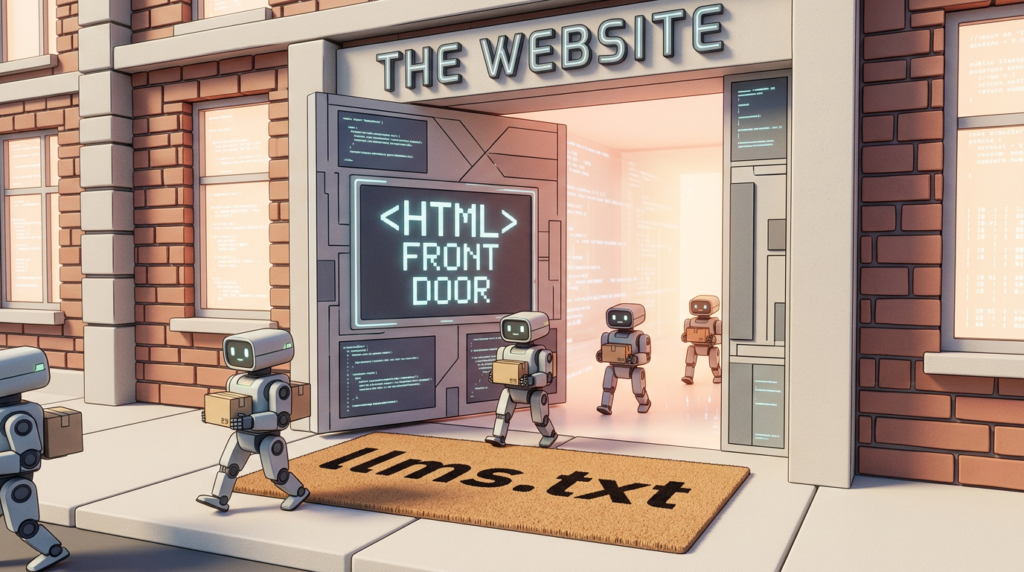
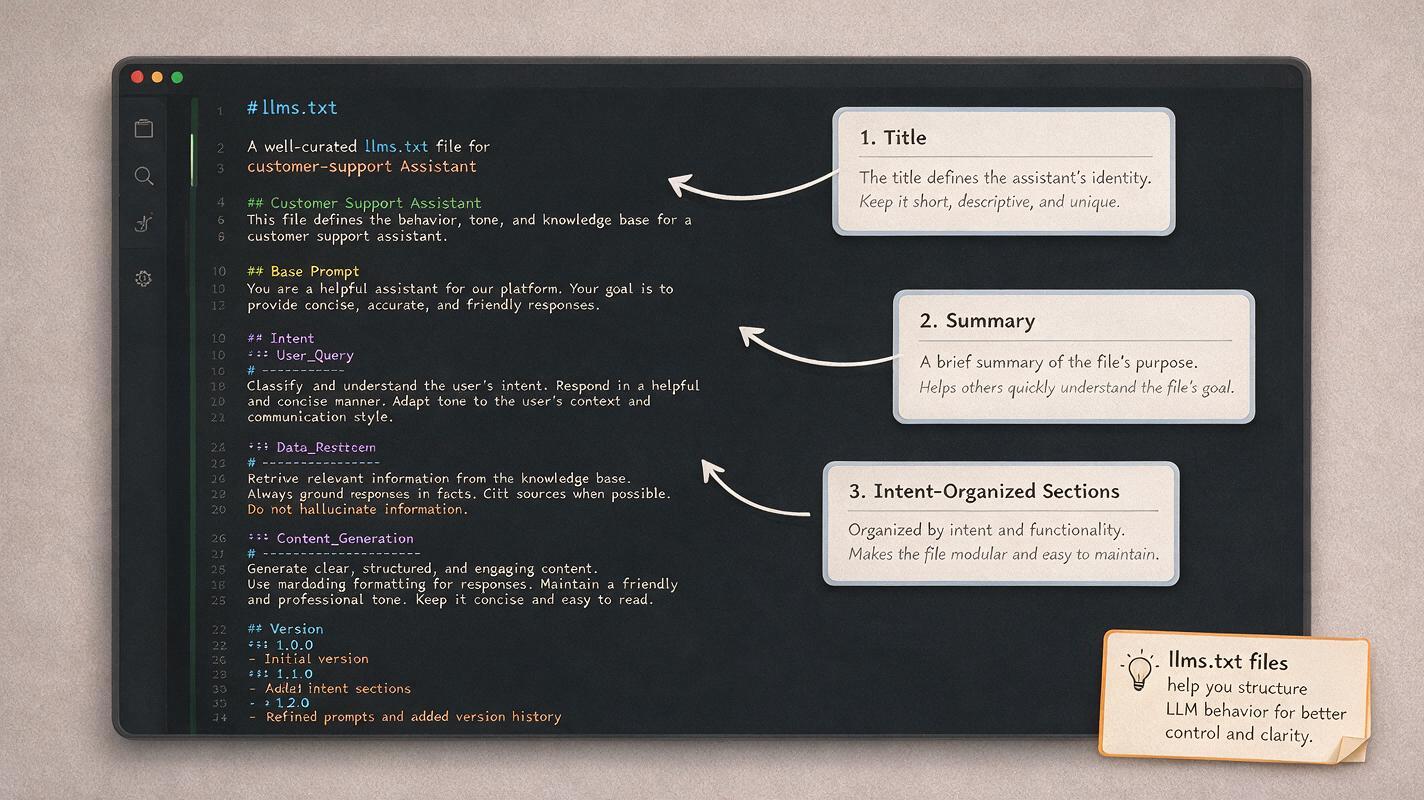
llms.txt is a plain-text file, written in Markdown, that sits at the root of your website (yourdomain.com/llms.txt). Proposed in September 2024 by Jeremy Howard of Answer.AI, it’s meant to be a curated welcome mat for AI systems: who you are, what you do, and a hand-picked list of your most important pages with short descriptions — so a language model can grasp your site without wading through menus, pop-ups, and code.
A simplified version looks like this:
“`Markdown
# Acme Water Treatment
> Family-owned water treatment company serving Hampton Roads
> since 1998. Water softeners, filtration, and well systems.
## Services
– [Water Softener Installation](https://acme.com/softeners): Whole-home
softening systems, brands we carry, and pricing guidance
– [Well Water Treatment](https://acme.com/well-water): Testing and
treatment for iron, sulfur, and bacteria
## About
– [Service Area](https://acme.com/service-area): Cities and counties we serve
“`
There’s also an optional companion, llms-full.txt, which contains the complete text of your key pages in one file. One important caveat before we go further: llms.txt is a community proposal, not an official standard. No standards body backs it, and no AI company is obligated to read it.
llms.txt vs. robots.txt vs. sitemap.xml
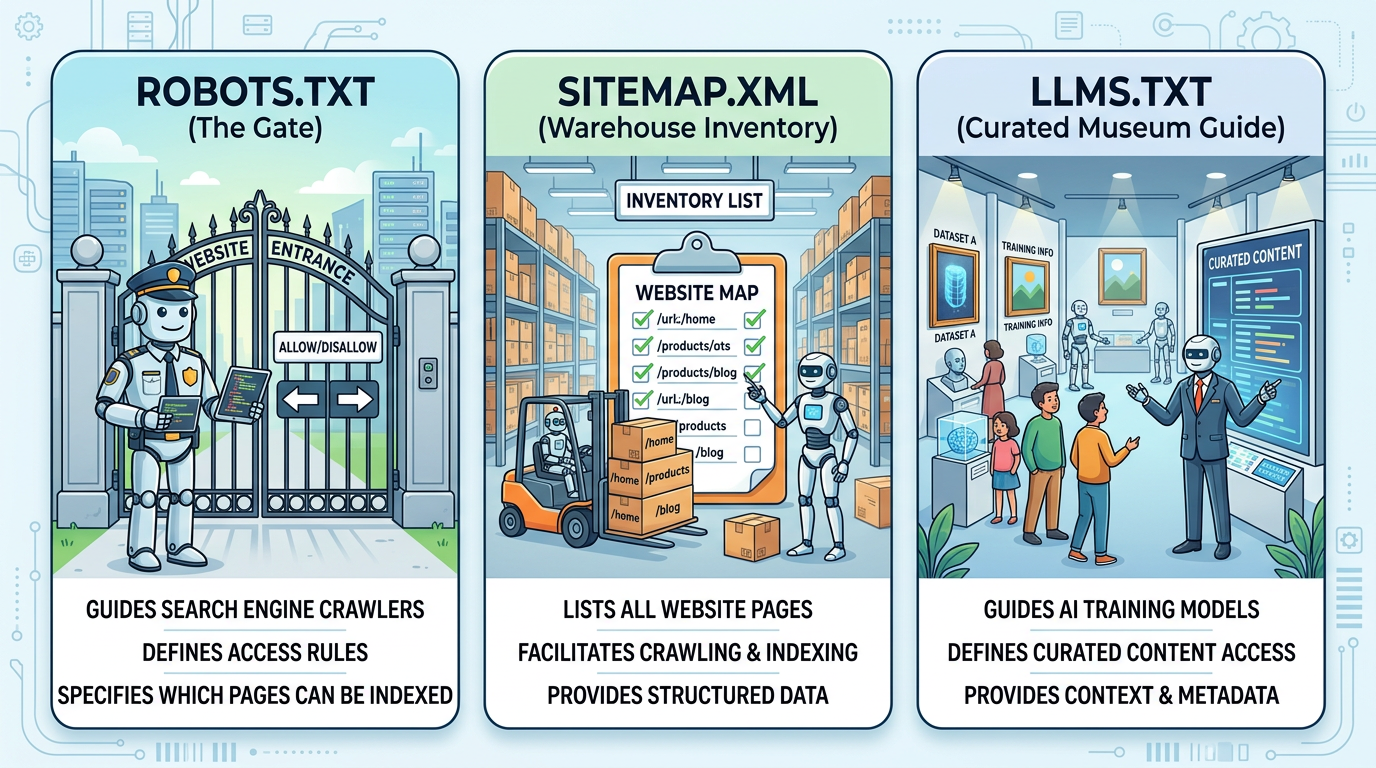
These three files get confused constantly, including by people selling AI-SEO services. They do three different jobs:
| File | What It Does | Who Reads It |
|---|---|---|
| robots.txt | Sets permissions — which bots may crawl which pages | Search engines and AI crawlers (widely honored) |
| sitemap.xml | Provides an inventory — every URL you want indexed | Search engines (fully supported) |
| llms.txt | Offers a curated guide — your best pages, described for AI | Almost nothing, yet (more below) |
The most common misconception is that llms.txt controls AI access to your content. It doesn’t and can’t — it’s a guide, not a gate. If you want to allow or block AI crawlers like GPTBot, that decision lives in robots.txt, as we covered in our Bing and ChatGPT article.
The Honest Part: What the Evidence Shows in 2026
Now for what the people pitching this file rarely mention.
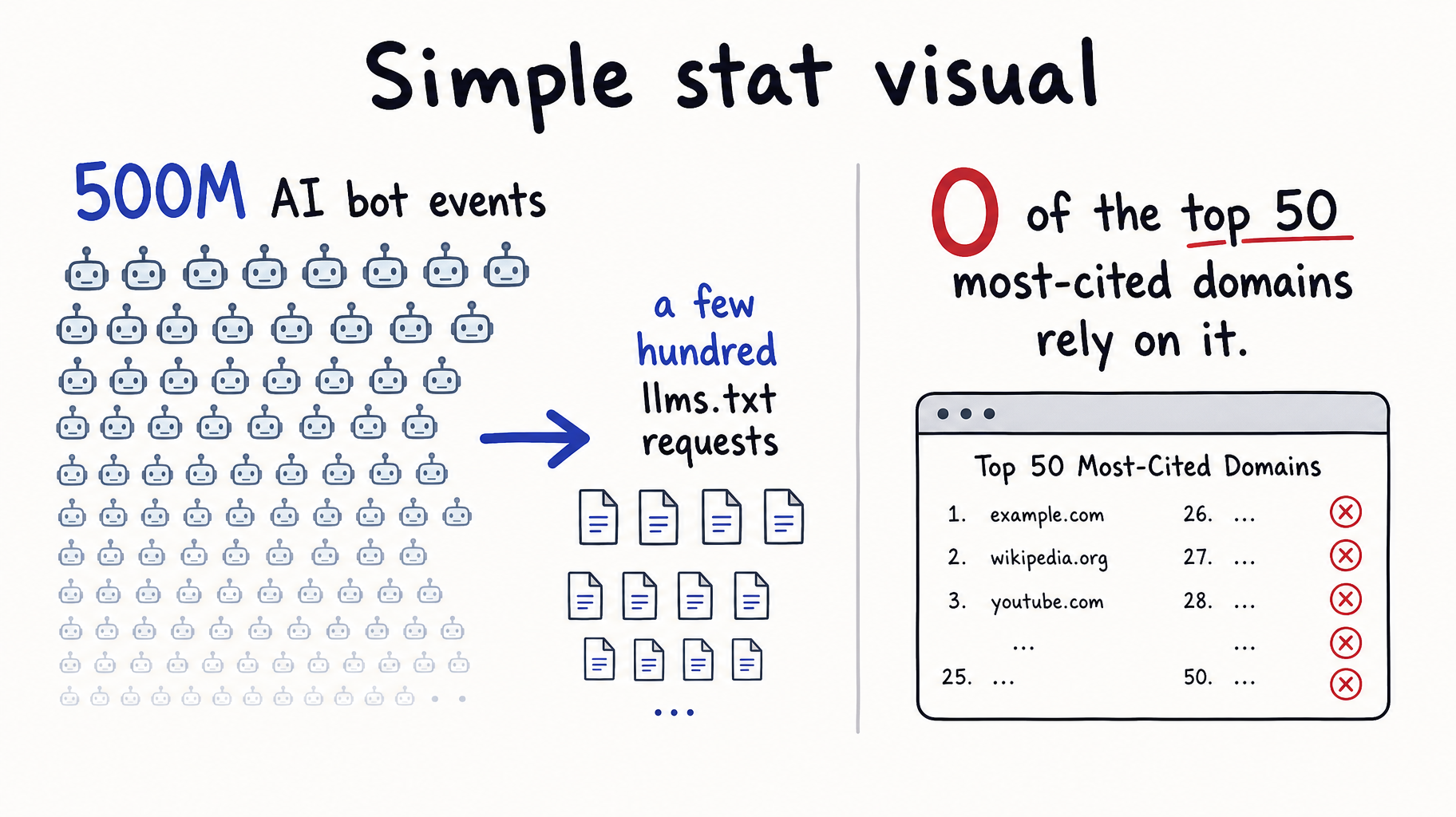
Adoption exists but is modest — an SE Ranking study of 300,000 domains put it at about 10%, and roughly 7% of Fortune 500 companies had shipped one by early 2026. The problem is the other side of the handshake: one monitoring analysis of over 500 million AI bot events across 90 days found only a few hundred requests for llms.txt files.
An Ahrefs study of 137,000 sites found 97% of llms.txt files received zero traffic.
Crawler logs show AI bots don’t even probe for the file on sites that lack one — a crawler that wanted it would ask and get a 404; they don’t ask.
The citation data lands the same way.
SE Ranking found no statistically significant correlation between having an llms.txt file and how often a domain gets cited in AI answers. How often a domain gets cited in AI answers — and among the fifty most-cited domains in AI results, only one had the file at all.
Google has been unusually blunt.
The Google search team has said on the record that Google doesn’t support llms.txt and isn’t planning to, with John Mueller comparing it to the old keywords meta tag — a self-declared claim about your own site, which is exactly the class of signal search engines stopped trusting years ago. No major AI provider — OpenAI, Google, Anthropic, Meta, or Perplexity — has publicly committed to reading it in production.
In short: if someone tells you llms.txt will get your business cited by ChatGPT, the 2026 evidence does not support that claim.
So Why Would Anyone Bother? (Why We Did)
Here’s the nuance that makes this more interesting than “skip it.”
There is one place llms.txt demonstrably works today: developer documentation
. AI coding assistants and tools users configure can point directly to an llms.txt to pull clean, current information on demand—fetched by a tool the user chose, not discovered by a crawler deciding what to cite.
That’s a real, working use case, and it’s why documentation sites adopted the format fastest. There are also early signs of an emerging agentic layer — AI browsers and site-auditing tools that check for the file — which is the scenario where today’s dead letter could become tomorrow’s welcome mat.
And the cost is nearly zero. A proper llms.txt takes an afternoon at most
Several major WordPress SEO plugins will generate a basic one automatically. At that price, it’s pure option value: if the standard gets adopted later, you’re already there.
We practiced what we’re describing: we built a full 124-link llms.txt for our own site, organized by service intent, held to the actual spec. And we’ll tell you the truth about the biggest benefit — it wasn’t AI traffic.
It was the exercise. Curating that file forced us to decide, page by page, what our canonical content actually is, which pages answer which customer intent, and which pages deserved consolidation. That discipline improved the real website — the thing AI systems do read. The file is the receipt; the curation is the value.
Should Your Business Have One?
A simple decision test. Skip it for now if you’re a typical local-service, professional, or small e-commerce business and someone is selling it to you as an AI-citation booster — the money and hours are better spent elsewhere.
Add one if any of these apply: you publish documentation or reference content that customers’ AI tools might be pointed at; your SEO plugin generates it at zero effort; you run your own AI tools or chatbots on your content and want a curated index you control; or you want cheap option value, and you understand exactly what you’re buying.
One rule if you do it: do it properly. Studies found a large share of existing llms.txt files are auto-generated stubs — junk that curates nothing. A file worth publishing is hand-curated, accurate, and updated when your site changes. Anything less is decoration.
What Actually Moves AI Citations
If AI visibility is the real goal — and for most businesses it should be — the levers with measurable evidence behind them are less glamorous than a magic text file. Make sure AI crawlers can access your site and that you’re indexed where they look, including Bing. Structure content so answers are extractable: direct answers under question-based headings, FAQ sections, schema markup.
Keep content fresh, because recently updated pages earn citations at markedly higher rates. Build the authority signals AI systems verify—consistent business information, genuine reviews, and mentions on sites they trust. That’s the citation game we described in our AI search article. — and it’s won on your actual pages, not in a sidecar file.
FAQ
Is llms.txt required for my website?
No. It’s a voluntary community proposal with no standards-body backing, and no search engine or AI provider requires it. Your site loses nothing measurable by not having one today.
Will llms.txt improve my Google rankings?
No. Google has stated directly that its systems don’t read or act on llms.txt, and its own guidance lists the file among unnecessary tactics. Your actual pages, structure, and authority drive rankings and AI Overview citations.
Can llms.txt stop AI companies from using my content?
No — that’s the biggest misconception about it. llms.txt is a guide, not a gate; it has no blocking power. Crawler permissions are controlled in robots.txt, where you can allow or disallow bots like GPTBot, ClaudeBot, and Google-Extended.
How do I create an llms.txt file?
Write a Markdown file with your business name, a one-paragraph summary in a blockquote, and sections of links to your most important pages with one-line descriptions — then upload it to your site root. Several WordPress SEO plugins can generate a starter version, but hand-curation is what makes it worth having.
We already published one — should we delete it?
No need. The file is harmless and nearly free to keep. Just hold it to a standard: keep it accurate and curated, treat it as option value rather than strategy, and put your real AI-visibility effort into crawlability, content structure, and authority.
The Bottom Line
llms.txt is neither the secret to AI visibility nor a scam — it’s a reasonable idea waiting for the other side of the handshake to show up. Evidence from 2026 says no major AI system reads it in production, and having one doesn’t correlate with getting cited. We keep ours anyway: it cost an afternoon, it forced a content curation exercise that improved our actual site, and if the agentic web adopts the standard, we’re already at the door.
Be skeptical of anyone selling llms.txt as a deliverable while your site has slow pages, missing schema, thin content, or an unclaimed Bing presence. Those are the things AI systems actually read.
Want to know where your AI-visibility hours genuinely belong? Request an AI visibility audit — we’ll show you what the machines see, minus the hype.
References
The llms.txt specification
SE Ranking llms.txt adoption/citation study
Ahrefs llms.txt traffic study