

Do City Pages Still Work in 2026? An Honest Answer From an Agency Running 144 of Them
Few local SEO tactics generate more conflicting advice than city pages. Half the industry calls them essential for service-area businesses; the other half calls them doorway spam that Google buried years ago. Business owners are left wondering whether the “Norfolk Plumbing” and “Chesapeake Plumbing” pages their last agency built are assets or liabilities.
We have skin in this game.
Our own website runs 144 city pages across six states, and we build location pages for service-area clients. So here’s the practitioner’s answer — including when city pages genuinely work, when they’re a waste of money, and the rules we hold our own pages to.
Why City Pages Exist in the First Place
A city page (or local landing page) targets searches for a service in a specific place — “crawl space repair Chesapeake,” “water treatment Suffolk.” They exist because of a structural gap: a service-area business works across dozens of cities. Still, its Google Business Profile is anchored to one address, and its homepage can’t rank everywhere at once. If you serve fifteen markets, you need fifteen answers to “do they work here?” — and a page per market is how the web answers that question.
That’s the legitimate version. The non-legitimate version is the same template photocopied fifty times with the city name swapped — and that version is why this debate exists.
How City Pages Got Their Bad Name
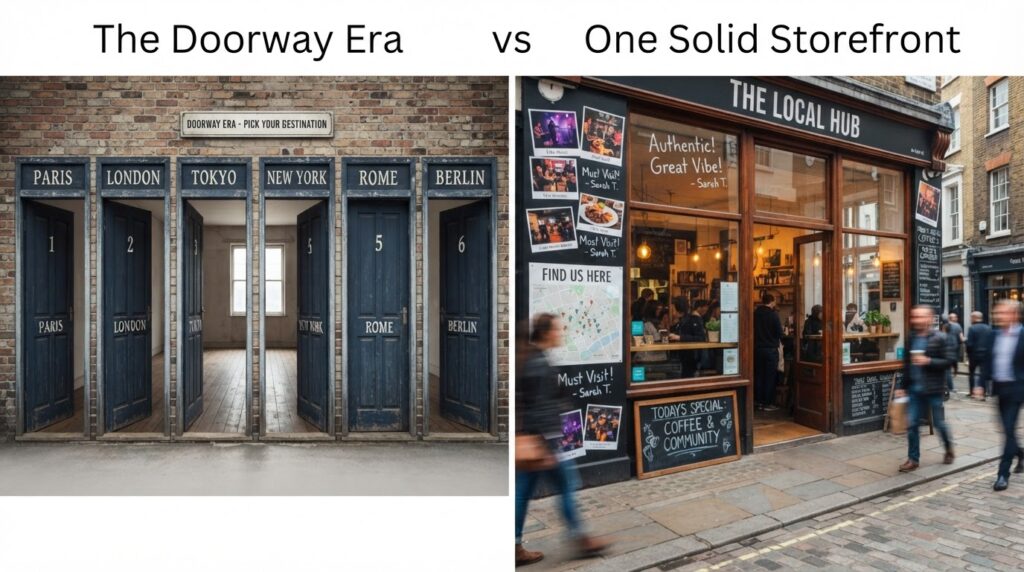
 Google’s doorway page update landed back in March 2015, specifically targeting near-identical pages created only to rank for place names — and enforcement never stopped. What’s changed is the mechanism: outright penalties still happen for egregious cases, but in 2026 the more common fate for thin location pages is quieter — they get suppressed, filtered, or grouped so only one representative page ever shows. The pages sit in your CMS looking like a strategy while doing nothing.
Then AI poured gasoline on the problem.
Generating 300 “unique” city pages now takes an evening, so the web is flooded with programmatic location content that all reads the same — and Google’s systems responded by raising the filtering bar for everyone. The irony of the AI content era: the easier city pages became to mass-produce, the harder they became to rank.
The tell-tale signs of the pages that get filtered haven’t changed
The signs included interchangeable content, no local proof, orphaned from the site’s navigation, and a giant footer listing forty cities. If a visitor lands, sees nothing about their actual city, and bounces back to the results, that behavior finishes what the template started.
The 2026 Verdict: Yes — But the Bar Moved
So do they still work? Yes. City pages remain one of the most effective visibility strategies available to service-area businesses — and in the AI era they’ve picked up a second job we’ll get to below. But the operating rule has inverted from a decade ago: fewer strong pages now outperform large batches of weak ones, and every page has to earn its existence.
The simplest quality test we know is the city-swap test
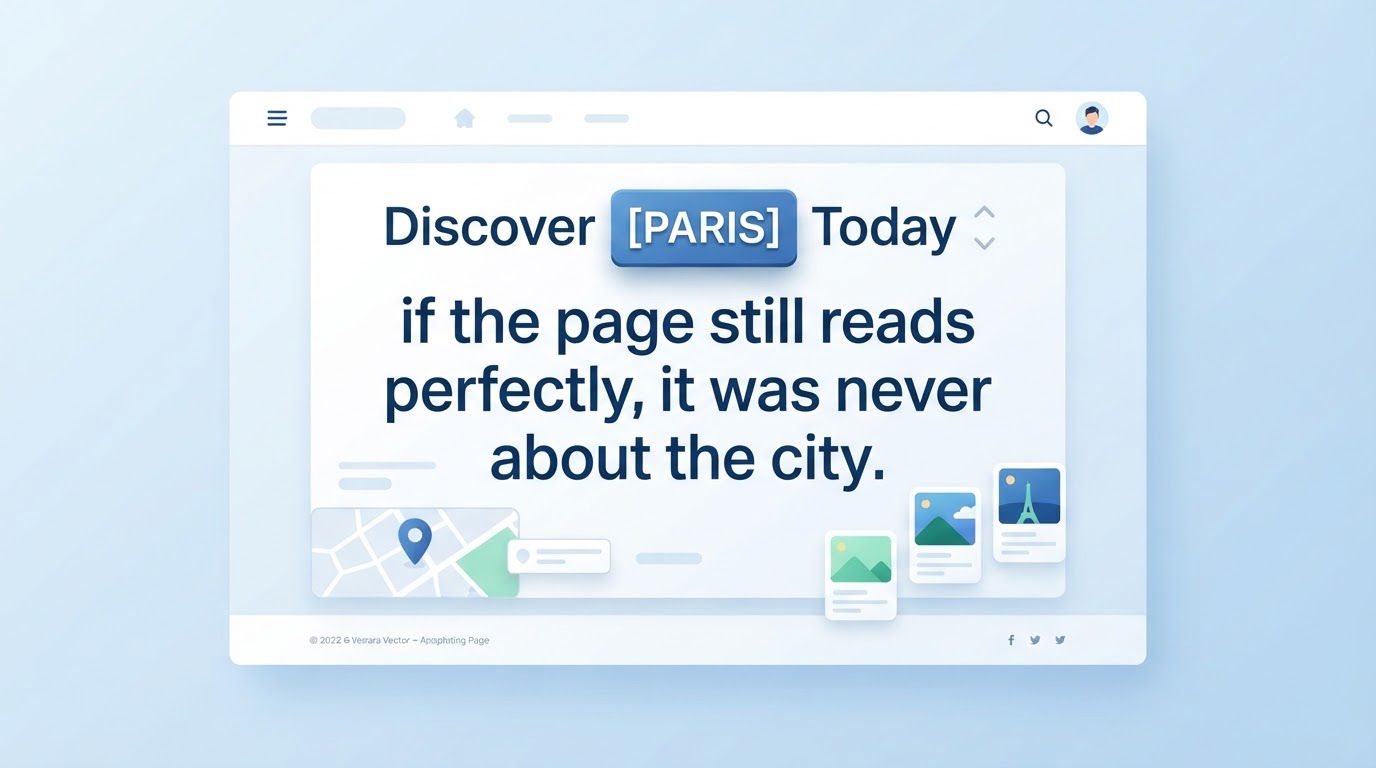
Read your Virginia Beach page, mentally swap in “Newport News,” and see if anything breaks. If the page still reads perfectly, it isn’t really about Virginia Beach — and Google’s systems reach the same conclusion at scale. What survives the test is local proof: things that are true about your work in that market and couldn’t be said about the next one.
Watch the verdict play out in Google Search Console
Healthy city pages accumulate impressions and clicks for service-plus-city queries. Filtered ones show the pattern every audit dreads: indexed but never surfacing, or stuck in “crawled — currently not indexed” purgatory. Page count was never the strategy; earning was.
The Rules We Hold Our Own 144 Pages To
Since we’re the agency running 144 of these, here’s the standard we apply to ourselves and our clients:
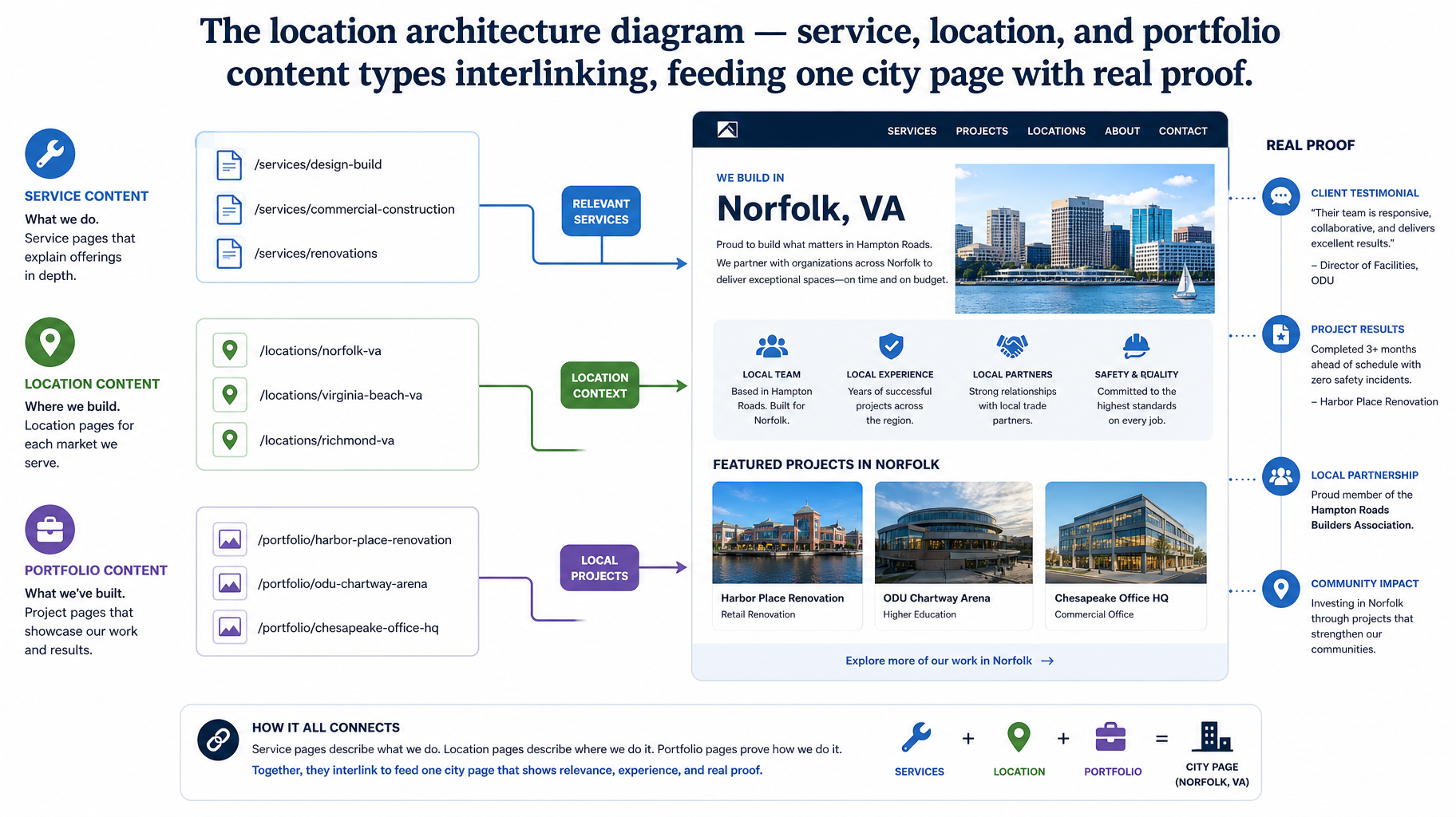
A page ships only when we have something true to say about that market. Real projects completed there, reviews from customers there, or service realities specific to the area. Our architecture enforces this — as we detailed in our rebuild case study, our locations, services, and portfolio items are structured content types that link to each other so that a city page can show actual work and proof for its market instead of adjectives.
Local means service-relevant, not landmark padding.
Mentioning the boardwalk doesn’t localize a page; explaining what coastal humidity does to a crawl space in a Tidewater flood zone does. The strongest local content answers “how is doing this job here different?” For example, soil, climate, housing stock, permits, and response times. If nothing about the service changes by market, that signals you need fewer, broader pages.
Architecture, not orphans
Every city page lives in the site’s real navigation — a service-area hub, logical internal links, its place in the sitemap. A location page reachable only by search engines is a doorway page by definition, whatever its word count.
Consistency and schema
Each page carries structured data that matches reality — the business, the service, the area served — and the details agree with our Google Business Profile and Bing Places listings to the letter. Machines cross-check; contradictions cost trust.
Publish in stages, measure, and prune. We roll pages out in batches, watch what earns impressions, strengthen what’s close, and consolidate what isn’t earning its place. A city page portfolio is a garden, not a monument.
The AI-Era Twist: City Pages as Geographic Evidence

Here’s what’s new in 2026, and why we’d build these pages even if classic rankings were the weaker argument.
AI systems — Google’s AI Overviews and AI Mode, ChatGPT, Perplexity — need clear geographic signals to answer the question behind every local query: who actually serves this place?
Well-built city pages are exactly that evidence: a crawlable, structured, verifiable statement of your service footprint that AI can cross-reference against your business profiles and reviews. When someone asks an AI assistant for “a good foundation repair company in Suffolk,” the systems assembling that answer are looking for businesses they can verify serve Suffolk.
A real city page — with proof, schema, and consistent business data — is how you raise your hand in a way machines trust. The thin template raises nothing.
When You Shouldn’t Build Them
Honesty cuts both ways, so skip city pages if you’re a single-location business customers walk into. Your Google Business Profile and one great local homepage do that job. Don’t build pages for cities you can’t genuinely serve or where you have zero proof; a page you can’t back up is a liability with a URL.
And if the plan is “have AI generate 300 of them tonight,” save the money — you’d be joining the exact spam wave the filters were built for.
FAQ
Are city pages doorway pages?
Not inherently. A doorway page exists only to capture a keyword and offers nothing specific to the place it names. A city page with real local proof — projects, reviews, market-specific service details, proper navigation and schema — is a legitimate landing page. Intent and substance draw the line, not the URL pattern.
How many city pages should my business create?
As many as you can genuinely support with proof, and no more. A service-area business is usually better served by eight strong pages for its core markets than forty interchangeable ones. Start with the cities where you have the most completed work and reviews, then expand in measured batches.
How much unique content does each page need?
Think in proof, not word counts — though in practice, a page that clears the bar usually has several hundred words of genuinely location-specific substance. The test is whether the page would survive the city-swap test, not whether it hits a number.
Do I need a physical address in every city?
No. Service-area businesses can legitimately target cities they serve without an office there. What you can’t fake is the serving part — response capability, completed work, and consistent service-area information across your website and business profiles.
Do city pages help with ChatGPT and AI Overviews?
Increasingly, yes. AI systems need verifiable geographic evidence to recommend businesses for local queries, and structured, proof-backed city pages provide that signal — especially when they match your Google and Bing business listings. Thin pages help nowhere; real ones help twice now.
The Bottom Line
City pages didn’t stop working in 2026 — lazy city pages did, and AI-scaled lazy city pages most of all. For service-area businesses, a measured portfolio of proof-backed location pages remains one of the highest-leverage visibility investments available, now doing double duty as the geographic evidence AI assistants verify before they recommend anyone.
Build fewer than you’re tempted to, back every one with something true, and prune like a gardener.
Wondering whether your existing city pages are earning their place or quietly filtered? Request a location page audit — we’ll pull the Search Console data and tell you which pages are working, which need proof, and which to consolidate.