

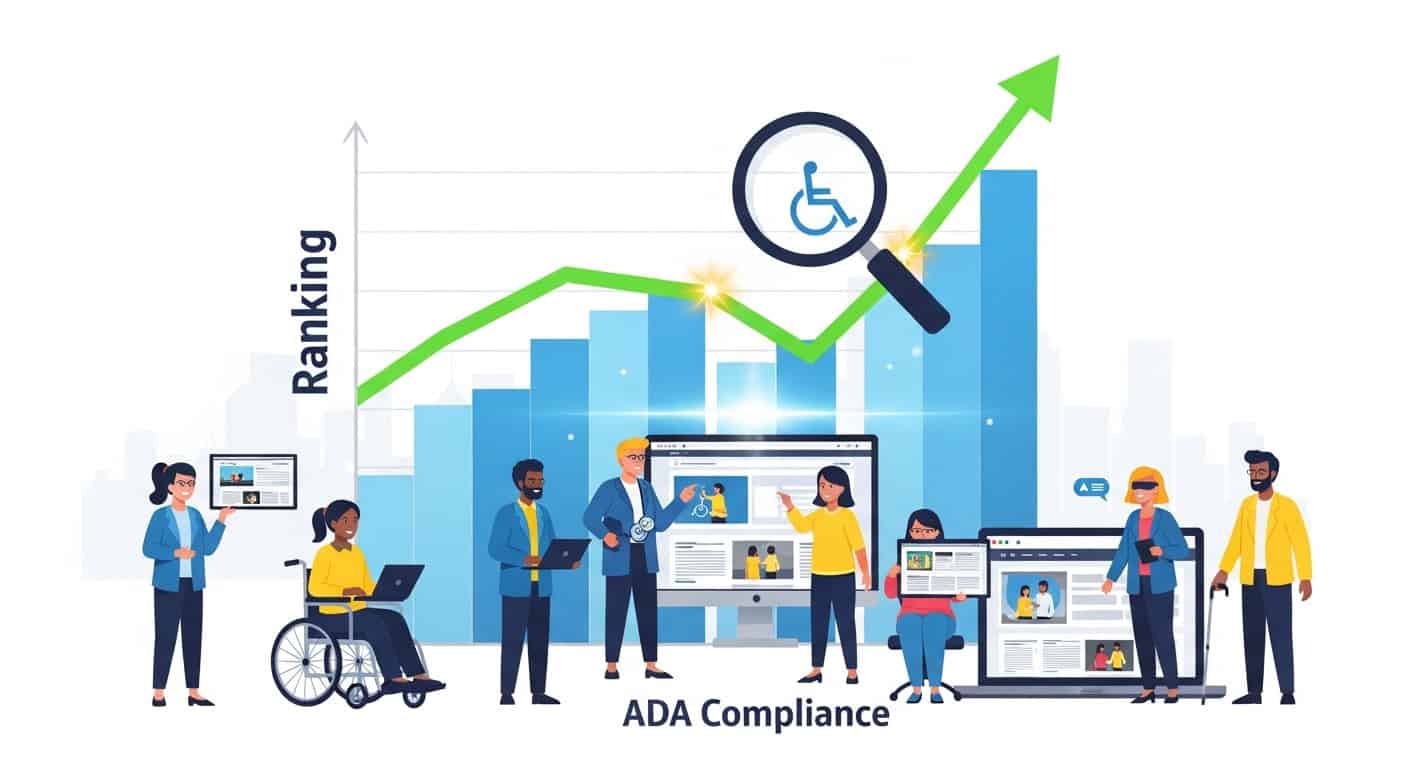
Understanding the technical overlap between accessible and SEO-friendly web design is crucial for achieving higher rankings.
On the other hand, many businesses view ADA compliance as a legal checkbox or a way to avoid lawsuits—a topic covered here: the Americans with Disabilities Act (ADA).
However, accessibility offers a massive, often overlooked benefit: it significantly boosts your SEO. The principles of SEO-friendly web design are almost identical to those of accessible design.
Google Bot is Your Most Frequent “Disabled” User

Core analogy: Google’s crawler is essentially a deaf and visually impaired user. It cannot “see” images; it reads ALT text.
Moreover, Google’s crawler cannot “watch” videos; it needs transcripts.
So, by designing for users who use screen readers, you also optimize your site for Google’s crawlers to understand your content.
The Technical Overlap: Where SEO and ADA Meet
- Screen readers use headers to navigate a page logically. Google uses them to understand the hierarchy and importance of content topics.
- ALT Text: Crucial for visually impaired users to know what an image contains; crucial for Google to index images for relevant keywords.
- Descriptive Anchor Text: “Click here” is bad for screen readers (they don’t know where “here” points) and for SEO (it doesn’t convey any keyword relevance). Descriptive links, like “learn more about our SEO services,” help both.
- Read: Google’s Web Fundamentals on Accessibility
- User Experience Signals (Core Web Vitals): Google wants to rank sites that offer a great user experience. For instance, accessible sites are generally cleaner, load faster, and are easier to navigate. These positive user signals (lower bounce rates, higher time on site) indirectly boost rankings.
Navigational Clarity

Accessible sites must be navigable with the keyboard alone to achieve a logical, clean site architecture, making it much easier for search engine spiders to crawl and index the entire site efficiently.
Therefore, stop viewing ADA compliance and SEO as separate tasks. They are two sides of the same coin: building a clear, logical, and universally understood website.
Good ethics and accessibility in web design lead to good rankings. Don’t forget to display your Website Accessibility Statement in your website footer or header.